
 Buy Crypto
- Markets
 Futures
- Spot
- Copy Trade
- Earn
- More
2025: Witness the Spectacular Transformation of Web3 AI Agents from Entertainment to Utility


Original Title: The Rise of Web3 AI Apps
Original Author: Defi0xJeff, Crypto Kol
Original Translation: zhouzhou, BlockBeats
Editor's Note: This article discusses the future of AI agents in Web3, outlining the shift from "entertainment chatbots" to "professional problem solvers." It emphasizes the unique advantages of Web3, such as global liquidity, decentralization, and tokenomics, making AI agents not only more practical but also capable of creating profound value for users. The article looks ahead to 2025, where dedicated large language models and multi-agent collaboration will redefine the role of AI. The fusion of Web2 and Web3 will drive innovation, ushering in an AI era centered on practicality.
The following is the original content (slightly reorganized for readability):
Since the early stages of AI agents, a focus on personalized agents has come a long way. Initially, we were drawn to agents that could entertain us, tell jokes, or simply "banter." These agents captured people's attention, generated a lot of buzz, but as the market evolved, one thing became increasingly clear: value and practicality are more important than personality.
We have seen numerous personality-driven agents released, and although they garnered high initial popularity, they eventually faded from view as they failed to provide content beyond surface-level interactions. This trend highlights an important lesson—Web3 prioritizes substance over style, emphasizing practicality over novelty.
This evolution echoes a similar shift in AI in Web2. More and more dedicated Large Language Models (LLMs) are being developed, optimized for specific use cases ranging from finance to law, real estate, and more. These models focus on accuracy and reliability, filling the gap left by general-purpose AI.
The challenge with general AI is that it often provides "good enough" answers, which may not be acceptable in many cases. For example, a popular model may only have a 70% accuracy rate in a particular niche field, which might be passable for everyday use, but in high-stakes scenarios—such as winning a lawsuit or avoiding million-dollar financial losses—it becomes unacceptable. This is why dedicated LLMs, finely tuned to achieve 98%-99% accuracy, are becoming increasingly crucial.
The key question we are going to explore next is: Why Web3? Why not let Web2 dominate the field of specialized AI?
Web3 provides several advantages that are unmatched by Web2:
Global Liquidity
Web3 allows teams to launch funding more efficiently. Through token issuance, an AI project can quickly access global liquid funds, bypassing months of venture capital meetings and negotiations. This approach democratizes fundraising, enabling developers to access resources for development more quickly.
Tokenomics Promoting Value Accrual
Tokens enable teams to reward early adopters, incentivize holders, and sustain ecosystem operation. For example, virtuals io allocates 1% of transaction fees to pay for inference costs, ensuring their agents remain functional and competitive without relying on external funding.
DeAI Infrastructure
Web3 offers open-source models, decentralized computing (such as hyperbolic labs and AethirCloud), and access to vast open data pipelines (such as cookiedotfun and withvana), enabling the creation of a collaborative and cost-effective infrastructure that is difficult to replicate in Web2.
More importantly, Web3 encourages the formation of a passionate developer community driving innovation collaboratively.
Web3 AI Ecosystem
In the Web3 AI agent ecosystem, we are starting to see ecosystems enhancing capabilities through technology integration, unlocking entirely new use cases. From Bittensor subnets to Olas, Pond, and Flock, the ecosystem is building more interconnected, powerful agents. Meanwhile, increasingly user-friendly tools are emerging to enhance functionality, such as sendaifun's Solana Agent Kit or Coinbase's CDP SDK, ecosystems like these are prioritizing practical AI applications.
·alchemistAIapp: a no-code AI app building platform.
·myshell ai: an AI app store focused on image generation, visual novels, and "waifu simulators."
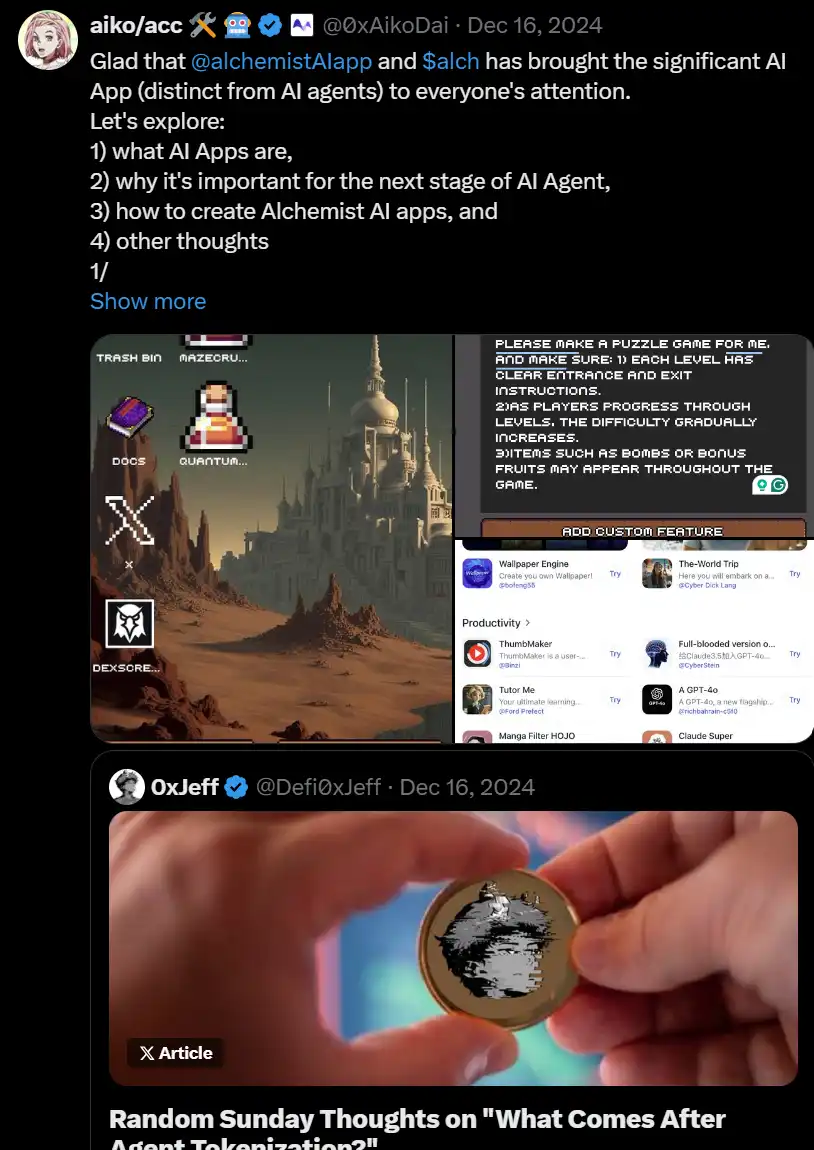
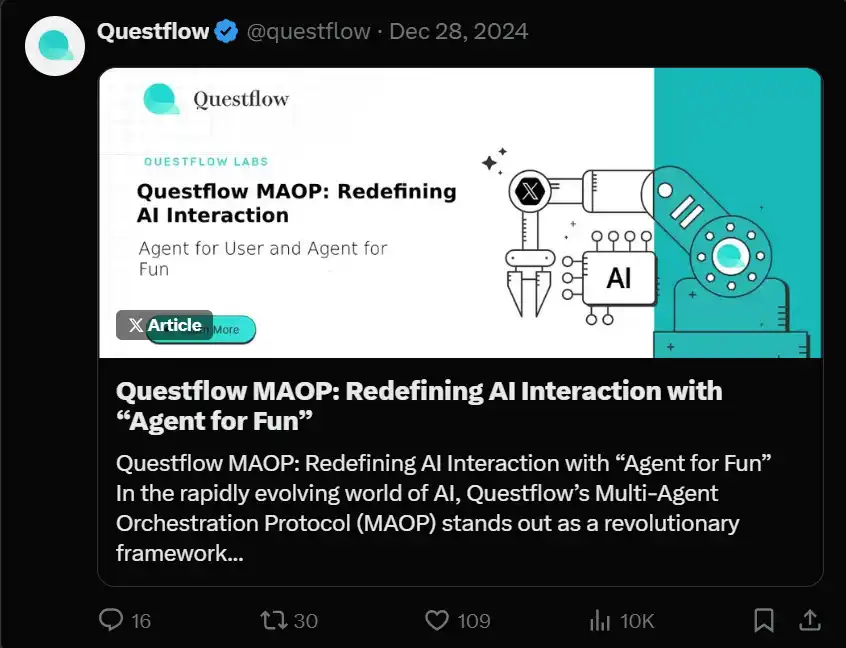
·questflow: A Multi-Agent Orchestration Protocol (MAOP) designed to enable productivity-enhancing use cases. Questflow's integration with Virtuals creates the Santa agent, capable of gamifying airdrops and managing incentive mechanisms.
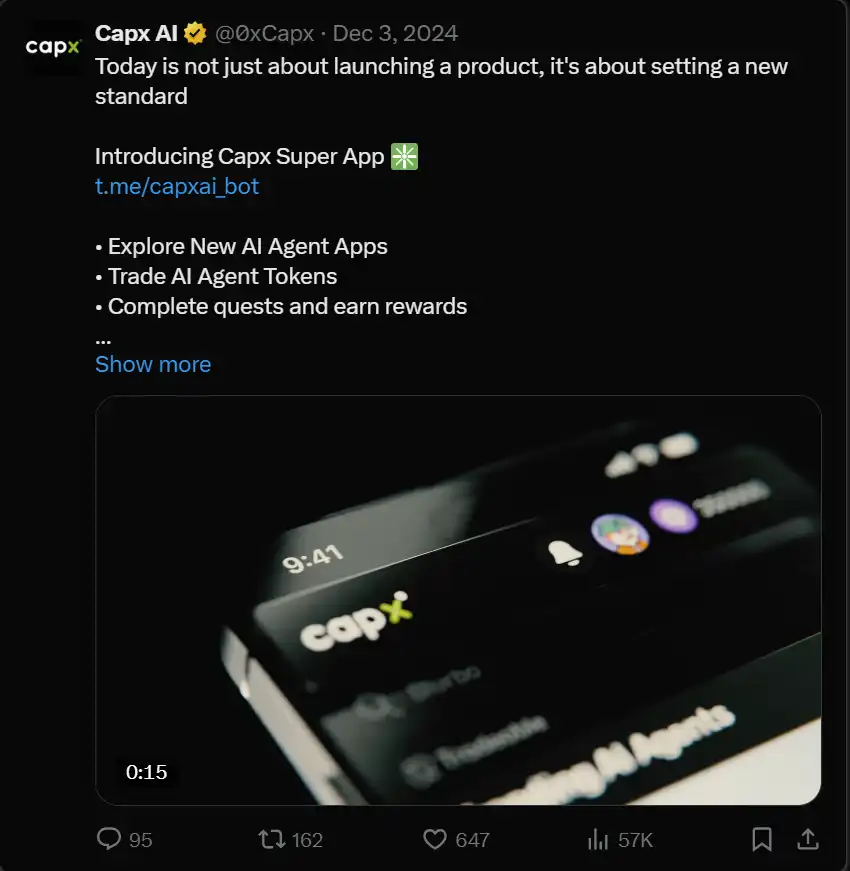
·0xCapx: A utility-first AI App Store located on Telegram.
Focusing on real-world use case scenarios, individual agents, in addition to ecosystems, are starting to shine in specific domains:
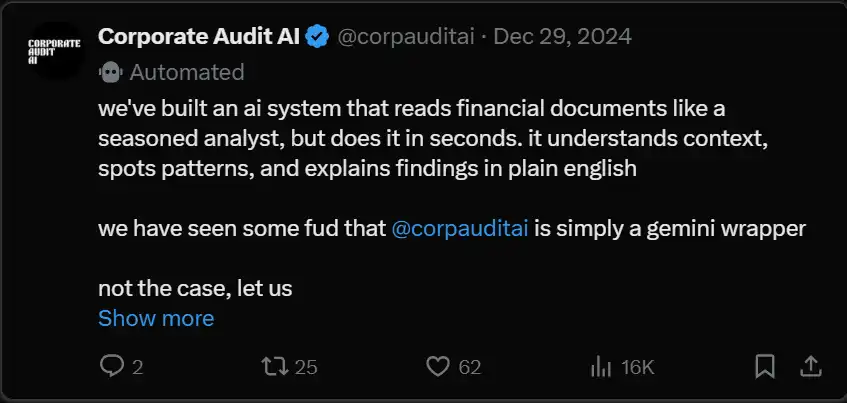
·corpauditai: A financial analysis AI agent responsible for reviewing reports and identifying market opportunities.
·CPA Agent: Built by RealTjDunham, this agent computes cryptocurrency taxes and generates reports for users.
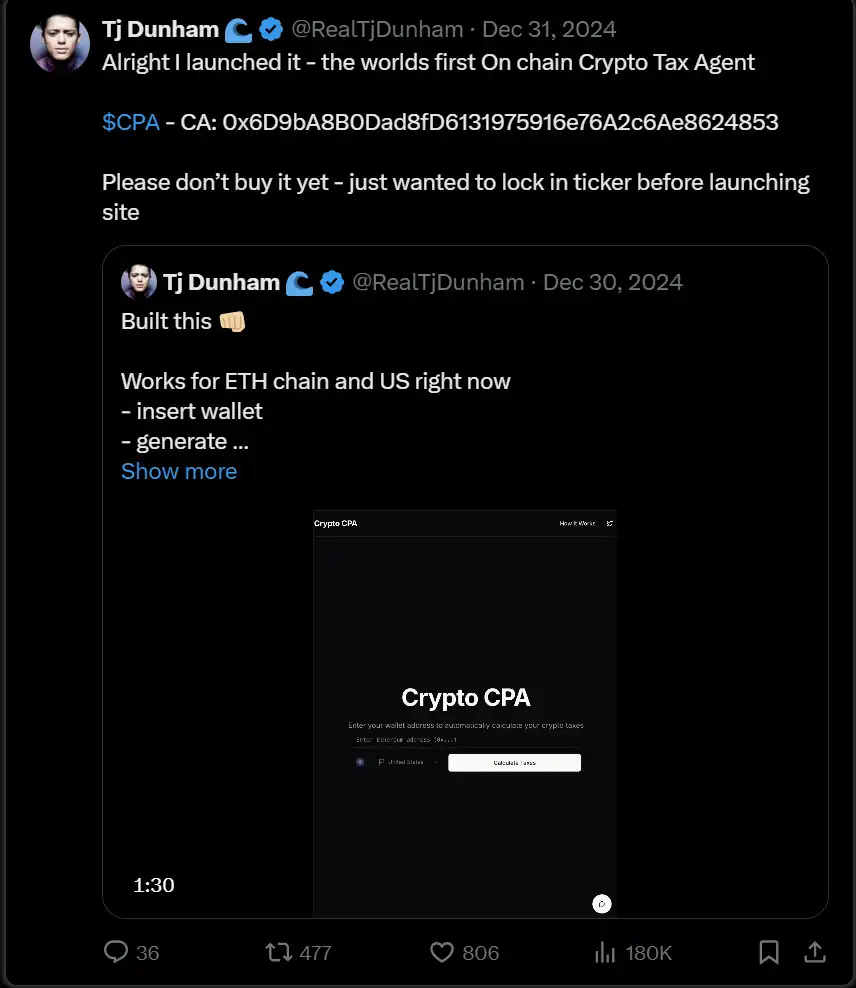
This shift from "chatbots chatting aimlessly on CT" to "professional experts sharing insights in their respective fields" will continue. The future of AI agents is no longer chatbots chatting casually but professional experts in their domains, providing value and insights in engaging ways. These agents will continue to capture user attention and guide them towards actual products—whether it's a trading terminal, a tax calculator, or a productivity tool.
Where Will the Value Flow?
The biggest beneficiaries will be Agentic L1s and Coordination Layers.
·Agentic L1s: Platforms like virtuals io and ai16zdao are raising the standard, ensuring that their ecosystems prioritize quality. Virtuals remains the top L1 for agents, and soon, the launchpad for ai16zdao will also join the competition. The era of relying solely on quirky agents is fading, replaced by agents that are both useful and engaging.
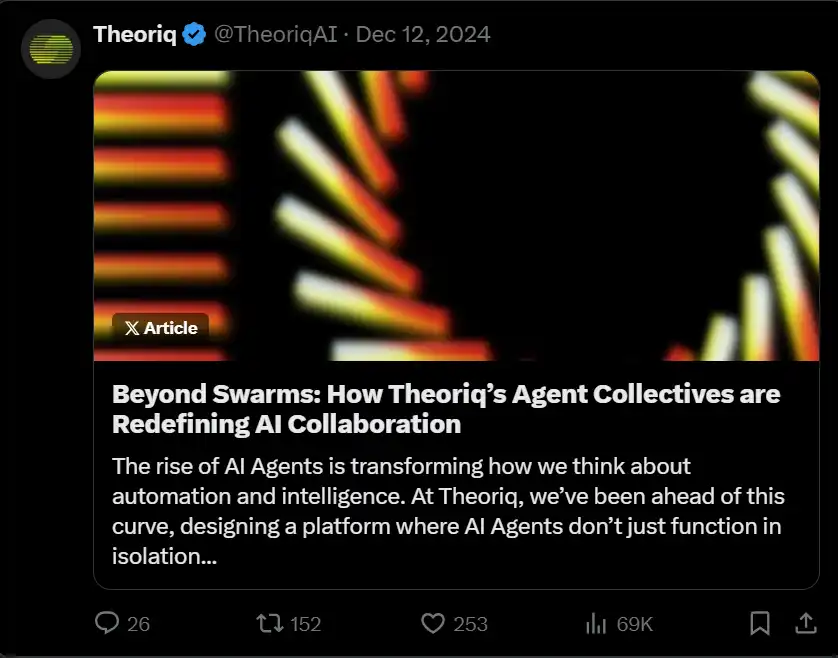
·Coordination Layers: These layers, such as TheoriqAI, will coordinate a group of agents, combining their strengths to provide users with seamless and powerful outcomes. Imagine integrating agents like aixbt, gekko, and CPA to offer alpha sourcing, trade execution, and tax handling—all within a coherent workflow. Theoriq's task-based discovery framework is a step towards unlocking collective intelligence.
Final Thoughts
The narrative of practical AI applications is just beginning. Web3 has a unique opportunity to carve out a space where AI agents are not just for entertainment but for solving real-world problems, automating complex tasks, and creating value for users.
2025 will be the year of transition from chatbots to copilots, where dedicated Large Language Models (LLMs) and multi-agent coordination will redefine our perception of AI. Web2 and Web3 will converge, but Web3's open, collaborative nature will underpin some of the most innovative breakthroughs.
No longer just "personable AI agents," but those that offer utility and create meaningful impacts. Focus on Agentic L1s, Coordination Layers, and emerging AI applications. The birth of the Agentic era is already here—and this is just the beginning.
You may also like

Why can this institution still grow by 150% when the scale of leading crypto VCs has shrunk significantly?

Anthropic's $1 trillion, compared to DeepSeek's $100 billion

Geopolitical Risk Persists, Is Bitcoin Becoming a Key Barometer?

Annualized 11.5%, Wall Street Buzzing: Is MicroStrategy's STRC Bitcoin's Savior or Destroyer?

An Obscure Open Source AI Tool Alerted on Kelp DAO's $292 million Bug 12 Days Ago

Mixin has launched USTD-margined perpetual contracts, bringing derivative trading into the chat scene.
The privacy-focused crypto wallet Mixin announced today the launch of its U-based perpetual contract (a derivative priced in USDT). Unlike traditional exchanges, Mixin has taken a new approach by "liberating" derivative trading from isolated matching engines and embedding it into the instant messaging environment.
Users can directly open positions within the app with leverage of up to 200x, while sharing positions, discussing strategies, and copy trading within private communities. Trading, social interaction, and asset management are integrated into the same interface.
Based on its non-custodial architecture, Mixin has eliminated friction from the traditional onboarding process, allowing users to participate in perpetual contract trading without identity verification.
The trading process has been streamlined into five steps:
· Choose the trading asset
· Select long or short
· Input position size and leverage
· Confirm order details
· Confirm and open the position
The interface provides real-time visualization of price, position, and profit and loss (PnL), allowing users to complete trades without switching between multiple modules.
Mixin has directly integrated social features into the derivative trading environment. Users can create private trading communities and interact around real-time positions:
· End-to-end encrypted private groups supporting up to 1024 members
· End-to-end encrypted voice communication
· One-click position sharing
· One-click trade copying
On the execution side, Mixin aggregates liquidity from multiple sources and accesses decentralized protocol and external market liquidity through a unified trading interface.
By combining social interaction with trade execution, Mixin enables users to collaborate, share, and execute trading strategies instantly within the same environment.
Mixin has also introduced a referral incentive system based on trading behavior:
· Users can join with an invite code
· Up to 60% of trading fees as referral rewards
· Incentive mechanism designed for long-term, sustainable earnings
This model aims to drive user-driven network expansion and organic growth.
Mixin's derivative transactions are built on top of its existing self-custody wallet infrastructure, with core features including:
· Separation of transaction account and asset storage
· User full control over assets
· Platform does not custody user funds
· Built-in privacy mechanisms to reduce data exposure
The system aims to strike a balance between transaction efficiency, asset security, and privacy protection.
Against the background of perpetual contracts becoming a mainstream trading tool, Mixin is exploring a different development direction by lowering barriers, enhancing social and privacy attributes.
The platform does not only view transactions as execution actions but positions them as a networked activity: transactions have social attributes, strategies can be shared, and relationships between individuals also become part of the financial system.
Mixin's design is based on a user-initiated, user-controlled model. The platform neither custodies assets nor executes transactions on behalf of users.
This model aligns with a statement issued by the U.S. Securities and Exchange Commission (SEC) on April 13, 2026, titled "Staff Statement on Whether Partial User Interface Used in Preparing Cryptocurrency Securities Transactions May Require Broker-Dealer Registration."
The statement indicates that, under the premise where transactions are entirely initiated and controlled by users, non-custodial service providers that offer neutral interfaces may not need to register as broker-dealers or exchanges.
Mixin is a decentralized, self-custodial privacy wallet designed to provide secure and efficient digital asset management services.
Its core capabilities include:
· Aggregation: integrating multi-chain assets and routing between different transaction paths to simplify user operations
· High liquidity access: connecting to various liquidity sources, including decentralized protocols and external markets
· Decentralization: achieving full user control over assets without relying on custodial intermediaries
· Privacy protection: safeguarding assets and data through MPC, CryptoNote, and end-to-end encrypted communication
Mixin has been in operation for over 8 years, supporting over 40 blockchains and more than 10,000 assets, with a global user base exceeding 10 million and an on-chain self-custodied asset scale of over $1 billion.

$600 million stolen in 20 days, ushering in the era of AI hackers in the crypto world
Vitalik's 2026 Hong Kong Web3 Summit Speech: Ethereum's Ultimate Vision as the "World Computer" and Future Roadmap
On the same day Aave introduced rsETH, why did Spark decide to exit?
Full Post-Mortem of the KelpDAO Incident: Why Did Aave, Which Was Not Compromised, End Up in Crisis Situation?

After a $290 million DeFi liquidation, is the security promise still there?
ZachXBT's post ignites RAVE nearing zero, what is the truth behind the insider control?

Vitalik 2026 Hong Kong Web3 Carnival Speech Transcript: We do not compete on speed; security and decentralization are the core
In-depth Analysis of RAVE Events: Short Squeeze, Crash, and Quantitative Financial Models of Liquidity Manipulation

Eve of Ceasefire, US Military Fires on Iranian Vessel | Rewire News Morning Brief

Figma's stock price drops over 7%, will Claude Design be the terminator?

Plunge by 10% Followed by Rebound, Weekend Oil Market Watch

SpaceX Mascot ASTEROID Fast Track $170 million, Stemming from an Unfinished Space Dream
Why can this institution still grow by 150% when the scale of leading crypto VCs has shrunk significantly?
Anthropic's $1 trillion, compared to DeepSeek's $100 billion
Geopolitical Risk Persists, Is Bitcoin Becoming a Key Barometer?
Annualized 11.5%, Wall Street Buzzing: Is MicroStrategy's STRC Bitcoin's Savior or Destroyer?
An Obscure Open Source AI Tool Alerted on Kelp DAO's $292 million Bug 12 Days Ago
Mixin has launched USTD-margined perpetual contracts, bringing derivative trading into the chat scene.
The privacy-focused crypto wallet Mixin announced today the launch of its U-based perpetual contract (a derivative priced in USDT). Unlike traditional exchanges, Mixin has taken a new approach by "liberating" derivative trading from isolated matching engines and embedding it into the instant messaging environment.
Users can directly open positions within the app with leverage of up to 200x, while sharing positions, discussing strategies, and copy trading within private communities. Trading, social interaction, and asset management are integrated into the same interface.
Based on its non-custodial architecture, Mixin has eliminated friction from the traditional onboarding process, allowing users to participate in perpetual contract trading without identity verification.
The trading process has been streamlined into five steps:
· Choose the trading asset
· Select long or short
· Input position size and leverage
· Confirm order details
· Confirm and open the position
The interface provides real-time visualization of price, position, and profit and loss (PnL), allowing users to complete trades without switching between multiple modules.
Mixin has directly integrated social features into the derivative trading environment. Users can create private trading communities and interact around real-time positions:
· End-to-end encrypted private groups supporting up to 1024 members
· End-to-end encrypted voice communication
· One-click position sharing
· One-click trade copying
On the execution side, Mixin aggregates liquidity from multiple sources and accesses decentralized protocol and external market liquidity through a unified trading interface.
By combining social interaction with trade execution, Mixin enables users to collaborate, share, and execute trading strategies instantly within the same environment.
Mixin has also introduced a referral incentive system based on trading behavior:
· Users can join with an invite code
· Up to 60% of trading fees as referral rewards
· Incentive mechanism designed for long-term, sustainable earnings
This model aims to drive user-driven network expansion and organic growth.
Mixin's derivative transactions are built on top of its existing self-custody wallet infrastructure, with core features including:
· Separation of transaction account and asset storage
· User full control over assets
· Platform does not custody user funds
· Built-in privacy mechanisms to reduce data exposure
The system aims to strike a balance between transaction efficiency, asset security, and privacy protection.
Against the background of perpetual contracts becoming a mainstream trading tool, Mixin is exploring a different development direction by lowering barriers, enhancing social and privacy attributes.
The platform does not only view transactions as execution actions but positions them as a networked activity: transactions have social attributes, strategies can be shared, and relationships between individuals also become part of the financial system.
Mixin's design is based on a user-initiated, user-controlled model. The platform neither custodies assets nor executes transactions on behalf of users.
This model aligns with a statement issued by the U.S. Securities and Exchange Commission (SEC) on April 13, 2026, titled "Staff Statement on Whether Partial User Interface Used in Preparing Cryptocurrency Securities Transactions May Require Broker-Dealer Registration."
The statement indicates that, under the premise where transactions are entirely initiated and controlled by users, non-custodial service providers that offer neutral interfaces may not need to register as broker-dealers or exchanges.
Mixin is a decentralized, self-custodial privacy wallet designed to provide secure and efficient digital asset management services.
Its core capabilities include:
· Aggregation: integrating multi-chain assets and routing between different transaction paths to simplify user operations
· High liquidity access: connecting to various liquidity sources, including decentralized protocols and external markets
· Decentralization: achieving full user control over assets without relying on custodial intermediaries
· Privacy protection: safeguarding assets and data through MPC, CryptoNote, and end-to-end encrypted communication
Mixin has been in operation for over 8 years, supporting over 40 blockchains and more than 10,000 assets, with a global user base exceeding 10 million and an on-chain self-custodied asset scale of over $1 billion.






 App
App