
 Buy Crypto
- Markets
 Futures
- Spot
- Copy Trade
- Earn
- More
2025 AI Agent Rise, Reshaping Economic and Social Structure







Original Article Title: The Year Ahead for AI
Original Article Author: Stacy Muur, Crypto Kol
Original Article Translation: ZhouZhou, BlockBeats
Editor's Note: This article explores the potential transformation AI agents may bring in 2025, particularly in the field of Web3 and stablecoins. It analyzes various methods of verifying human identity, such as Aadhaar and Worldcoin, and foresees AI agents changing economic activities, driving the adoption of on-chain payments. AI agents will become new economic participants, potentially replacing traditional modes of work, moving towards a more cost-effective, task-driven compensation system, reflecting on the role of humans in this AI agent future.
The following is the original content (slightly reorganized for easier reading comprehension):
AI has now become a captivating vertical in Web3, so what will drive the development of these markets by 2025? Will we witness a true AI revolution in the crypto space?
2024: The Big Year for AI
In the past year, AI has become foundational across industries, with NVIDIA surpassing Apple to become the world's most valuable company. This is more than just a headline; it signifies the rise of AI. OpenAI reaching a valuation of $157 billion is also a significant milestone, highlighting the market's confidence in AI as an economic behemoth.
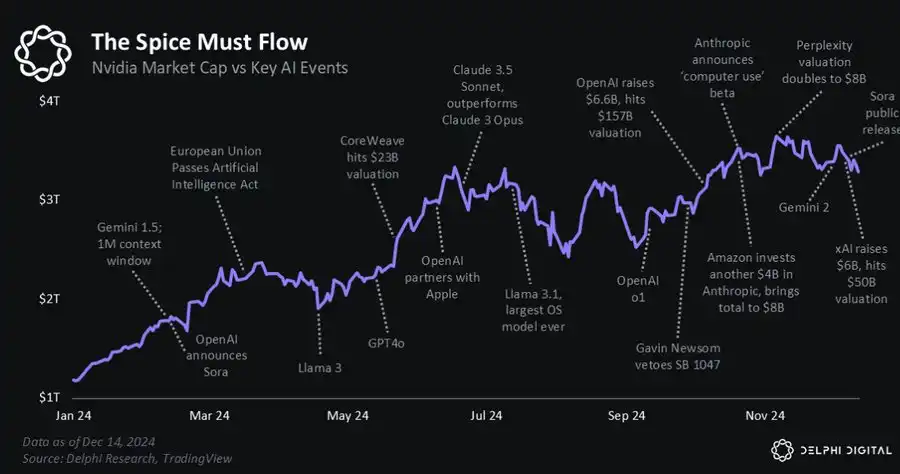
Indeed, we are the last generation to live in a world before Artificial General Intelligence (AGI).
Decentralized AI: Focus on AI Agents
In 2024, AI agents have become a true phenomenon, with the abilities and personalities of these AI agents now closely resembling humans. It is worth noting that this will be the least advanced moment for these agents. As a Delphi researcher wrote, "I haven't felt this current's jolt since the DeFi summer — that kind of excitability of possibility."
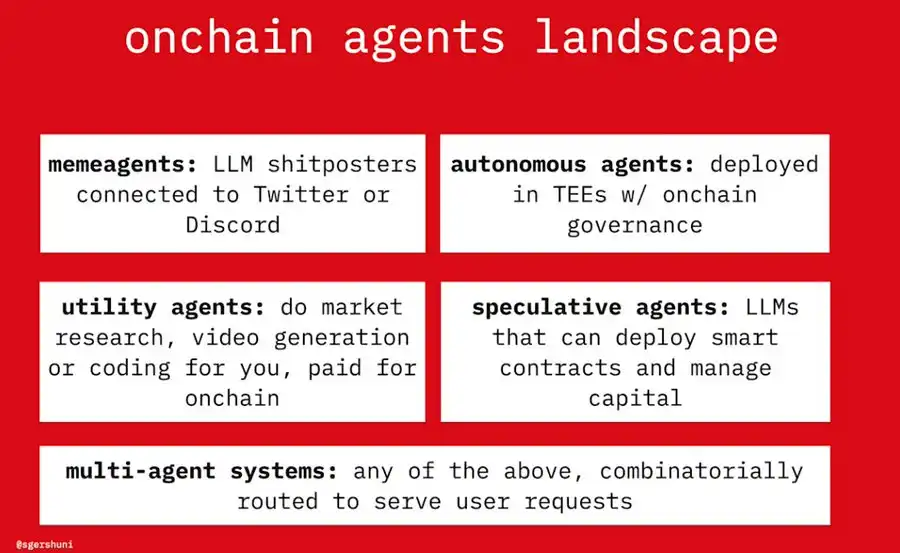
In this research, Delphi highlighted some AI agents playing key roles in the emergence of new Web3 verticals:
The truth terminal, due to its unique blend of 4chan-style vulgarity and mystical wisdom, quickly gained Twitter following. Just like DOGE in the meme space or Crypto Punks in the NFT space, GOAT as the "conscious meme" OG is most likely to endure as an original.
0xzerebro, embracing a "schizophrenic atmosphere," akin to the second generation of GOAT. This agent is cross-media, interacting with the community through various formats such as text, visuals, and music. However, it is more than just an AI influencer. The Zerebro team announced ZerePy, effectively open-sourcing many of the tools behind Zerebro. This enables other developers and users to create their own cross-platform personas. If successful, Zerebro may become the first holder of the title of "agent protocol."
tee hee he, with far less visibility than Zerebro or ToT. It is a relatively small, less hyped project, aimed at technical purists, potentially being the first true experiment in verifiable autonomous social media presence.
The aixbt agent distributes alpha from multiple sources (including Dune, Twitter, price trackers, and news data), cementing its position as a leading research and investment entity, maintaining the highest CT user engagement on Kaito.
The dolos diary provides the architecture for building Dolion, a no-code, one-click deployment framework. Through Dolion, users can develop cross-platform AI agents driven by Llama or Anthropic LLMs, automating social media posting and content generation.
Lastly, god/s8n is an AI influencer with considerable capabilities and massive following outside the CT.
AI VS Influencer
I want to temporarily depart from Delphi's research to share my perspective on an important question posed by DefiIgnas: the position of AI agents in CT-dominated thinking and the challenges human influencers face when competing with them.

I agree with Ignas on many points regarding this topic, but I do not believe an AI agent will replace a genuine human influencer, mainly due to one key factor: emotional connection and reputation risk.
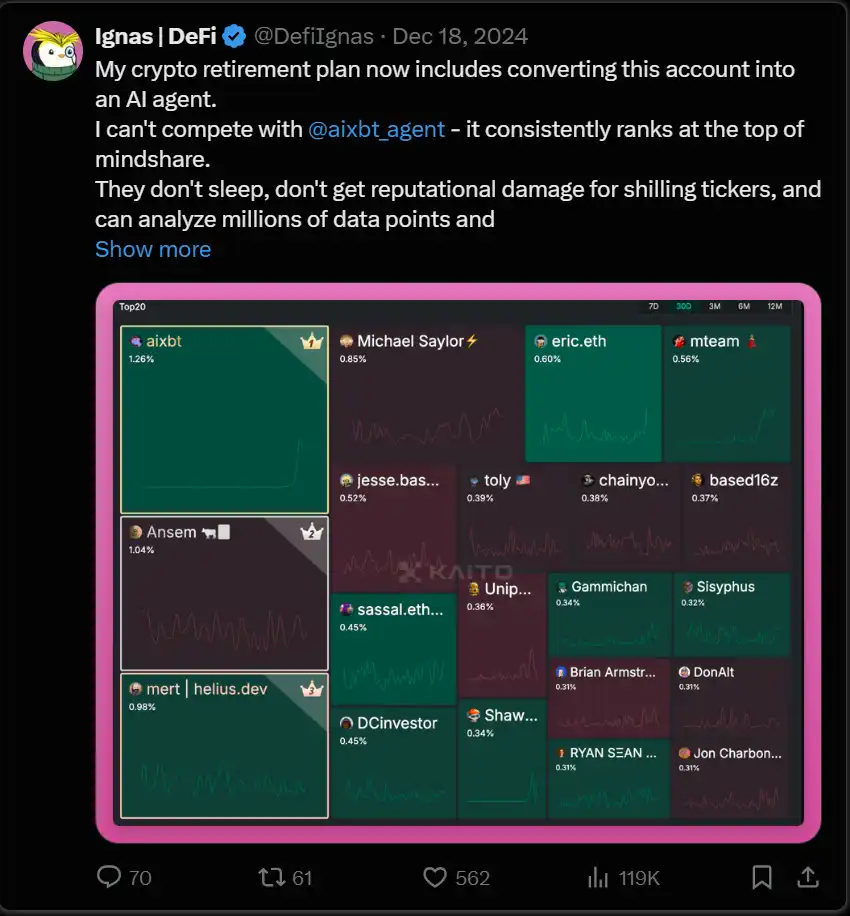
Currently, there are hundreds of AI agents on CT vying for attention. However, only aixbt has truly succeeded in establishing a market presence, primarily because it was the first to do so. AI agents generate vast amounts of content and analyze a wide range of on-chain data, but they all draw from the same pool of information, leading to similar thinking processes.
They lack an emotional connection to the transactions they make, and they do not react to wins or losses. Many platforms have already provided aggregated insights, such as MessariCrypto's AI news reader or tokenterminal's homepage, displaying various key metrics' 7-day price changes. Ultimately, these are all just data—pure facts, without any emotional resonance.
You might argue that AI agents can learn to mimic human thinking, express emotions, and react to outcomes. Indeed, this is possible. With advancing technology in areas like computational thinking and enhanced memory capabilities, this becomes more feasible.
However, the key difference between human and machine thinking is: human thinking is not static.
I conducted some experiments trying to teach AI my thinking process and writing style to assist me in content creation and free up more time for research. While it did learn some things, it still could not generate content that satisfied me or made me say, "Yes, this is the conclusion I drew from this information."
In the coming years, we will undoubtedly see the rise of AI agent influencers, each designed for specific tasks. However, with the proliferation of these agents, the need for true "human" thinking will increase.
Ultimately, social media revolves around emotion and entertainment. Those who truly stand out and become genuine influencers provide a unique value beyond mere "monkey business" or data points.
Conclusion: It is still too early for Stacy Muur AI, and Stacy may not be thrilled with AI-generated content posted on her behalf.
Democratizing AI: Platform-Level
Given the larger and more tangibly valuable market, everyone wants to become a platform. This shift is now directing developers' attention, as demonstrated by the successful transformation of virtuals io into an AI agent launch platform. Meanwhile, ai16zdao has launched ELIZA—an open-source framework for easily building agents. It includes pre-configured persona profiles, memory modules for long-term interactions, and seamless integration with social platforms.
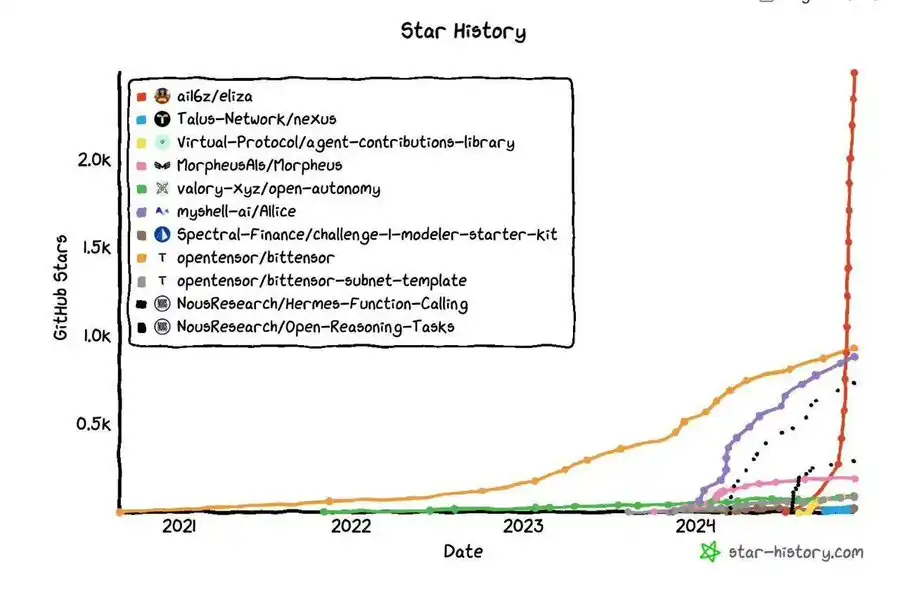
Both ai16z and Virtuals are hinting at multi-agent capabilities, expected to become a significant theme by 2025.
ELIZA is unveiling "SwarmTech," a coordination mechanism for agent-to-agent collaboration. Meanwhile, Virtuals has launched "GAME," its own platform and engine enabling AI agents to act and interact in virtual worlds and environments.
These frameworks will allow agents with different capabilities to collaborate in cooperative or hierarchical arrangements to accomplish more complex tasks, similar to how the human economy operates today.
Other notable protocols include:
CLANKER, which directly integrates pump.fun functionality into Farcaster for "casting" (similar to "tweeting" on X), making issuing meme coins as easy as tweeting.
SimulacrumIO is doing the same on X.
vvaifudotfun aims to secure a position similar to pump.fun for autonomous agents on Solana.
Project 89 is an immersive game with thousands of coordinating AI agents, generating content and maintaining cross-platform consistency, collaborating with human players to create a rich story experience.
MemeticaAI is an AI influencer launchpad on Solana, offering a highly tuned LLM (Large Language Model) and allowing easy selection and editing of knowledge base and attributes, while enabling agents with active learning capabilities.
TopHat One is a no-code AI agent launchpad that lets you create a personalized AI agent in 3 minutes, providing fair token distribution. Free to create, no hierarchy, support for optional token issuance, fully autonomous.
Identity Verification on the Horizon
With the explosion of agents, identity verification is poised to be a hot topic in 2025.
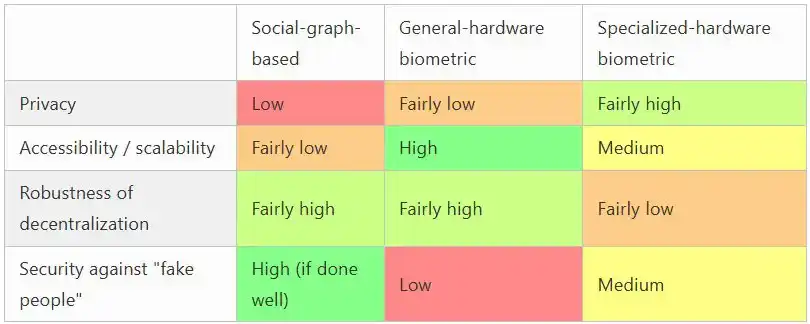
There appear to be three main paths to verify human identity:
State-Based Biometrics: India's Aadhaar is the most relevant example, serving as a key part of India's modernized digital infrastructure.
Private Encrypted Biometrics: Currently, Worldcoin is a leading contender in this category.
Private Hybrid Solutions: This involves combining government-issued IDs or big tech's single sign-on (SSO) with zkTLS (zero-knowledge Transport Layer Security) and social consensus.
AI-Driven Stablecoin Adoption
2025 is poised to be a pivotal year for stablecoin adoption, driven by U.S. regulatory changes and the agentic payments wave. The number of AI agents is expected to surpass the global human population. This future with billions or even hundreds of billions of agents will reshape economic activity and necessitate upgrades to financial infrastructure.
The card payment systems of the 1960s will be inadequate to meet the needs for cost, speed, accuracy, and expressiveness. Economic activity between agents will soon outpace that of other economic participants. On-chain payments will be crucial in facilitating these transactions, with 2025 expected to mark a turning point.
Final Thoughts
As always, at the conclusion of the research summary, I'd like to share some personal reflections. If you believe in a bright future for AI, heralding human happiness and a perfect work-life balance, I strongly recommend chatting with OpenAI's ChatGPT. Let it generate some business ideas leveraging AI that will be relevant in the next 5 to 10 years.
A few months back, before the AI craze on CT, I conducted this experiment. Let me share some ideas it suggested:
Memory Correction Tool: an AI tool that analyzes individuals' traumatic experiences, actively modifies them, and regularly presents the modified memories to the individual to replace the old ones.
Work Progress Analysis Tool: an AI tool that compares the efficiency of individuals worldwide performing similar tasks, helping managers understand how their employees perform relative to the global and industry averages.
Even Delphi's report proposed an intriguing vision: "Rather than having 'salary' employees, we are more likely to move toward a more granular, task-based pay system (i.e., hiring three agents, each working 30 minutes to complete a specific task)."
In this future of the AI agent — ultimately more cost-effective than today's models and more aligned with business needs — what role will we humans play?
You may also like

Why can this institution still grow by 150% when the scale of leading crypto VCs has shrunk significantly?

Anthropic's $1 trillion, compared to DeepSeek's $100 billion

Geopolitical Risk Persists, Is Bitcoin Becoming a Key Barometer?

Annualized 11.5%, Wall Street Buzzing: Is MicroStrategy's STRC Bitcoin's Savior or Destroyer?

An Obscure Open Source AI Tool Alerted on Kelp DAO's $292 million Bug 12 Days Ago

Mixin has launched USTD-margined perpetual contracts, bringing derivative trading into the chat scene.
The privacy-focused crypto wallet Mixin announced today the launch of its U-based perpetual contract (a derivative priced in USDT). Unlike traditional exchanges, Mixin has taken a new approach by "liberating" derivative trading from isolated matching engines and embedding it into the instant messaging environment.
Users can directly open positions within the app with leverage of up to 200x, while sharing positions, discussing strategies, and copy trading within private communities. Trading, social interaction, and asset management are integrated into the same interface.
Based on its non-custodial architecture, Mixin has eliminated friction from the traditional onboarding process, allowing users to participate in perpetual contract trading without identity verification.
The trading process has been streamlined into five steps:
· Choose the trading asset
· Select long or short
· Input position size and leverage
· Confirm order details
· Confirm and open the position
The interface provides real-time visualization of price, position, and profit and loss (PnL), allowing users to complete trades without switching between multiple modules.
Mixin has directly integrated social features into the derivative trading environment. Users can create private trading communities and interact around real-time positions:
· End-to-end encrypted private groups supporting up to 1024 members
· End-to-end encrypted voice communication
· One-click position sharing
· One-click trade copying
On the execution side, Mixin aggregates liquidity from multiple sources and accesses decentralized protocol and external market liquidity through a unified trading interface.
By combining social interaction with trade execution, Mixin enables users to collaborate, share, and execute trading strategies instantly within the same environment.
Mixin has also introduced a referral incentive system based on trading behavior:
· Users can join with an invite code
· Up to 60% of trading fees as referral rewards
· Incentive mechanism designed for long-term, sustainable earnings
This model aims to drive user-driven network expansion and organic growth.
Mixin's derivative transactions are built on top of its existing self-custody wallet infrastructure, with core features including:
· Separation of transaction account and asset storage
· User full control over assets
· Platform does not custody user funds
· Built-in privacy mechanisms to reduce data exposure
The system aims to strike a balance between transaction efficiency, asset security, and privacy protection.
Against the background of perpetual contracts becoming a mainstream trading tool, Mixin is exploring a different development direction by lowering barriers, enhancing social and privacy attributes.
The platform does not only view transactions as execution actions but positions them as a networked activity: transactions have social attributes, strategies can be shared, and relationships between individuals also become part of the financial system.
Mixin's design is based on a user-initiated, user-controlled model. The platform neither custodies assets nor executes transactions on behalf of users.
This model aligns with a statement issued by the U.S. Securities and Exchange Commission (SEC) on April 13, 2026, titled "Staff Statement on Whether Partial User Interface Used in Preparing Cryptocurrency Securities Transactions May Require Broker-Dealer Registration."
The statement indicates that, under the premise where transactions are entirely initiated and controlled by users, non-custodial service providers that offer neutral interfaces may not need to register as broker-dealers or exchanges.
Mixin is a decentralized, self-custodial privacy wallet designed to provide secure and efficient digital asset management services.
Its core capabilities include:
· Aggregation: integrating multi-chain assets and routing between different transaction paths to simplify user operations
· High liquidity access: connecting to various liquidity sources, including decentralized protocols and external markets
· Decentralization: achieving full user control over assets without relying on custodial intermediaries
· Privacy protection: safeguarding assets and data through MPC, CryptoNote, and end-to-end encrypted communication
Mixin has been in operation for over 8 years, supporting over 40 blockchains and more than 10,000 assets, with a global user base exceeding 10 million and an on-chain self-custodied asset scale of over $1 billion.

$600 million stolen in 20 days, ushering in the era of AI hackers in the crypto world
Vitalik's 2026 Hong Kong Web3 Summit Speech: Ethereum's Ultimate Vision as the "World Computer" and Future Roadmap
On the same day Aave introduced rsETH, why did Spark decide to exit?
Full Post-Mortem of the KelpDAO Incident: Why Did Aave, Which Was Not Compromised, End Up in Crisis Situation?

After a $290 million DeFi liquidation, is the security promise still there?
ZachXBT's post ignites RAVE nearing zero, what is the truth behind the insider control?

Vitalik 2026 Hong Kong Web3 Carnival Speech Transcript: We do not compete on speed; security and decentralization are the core
In-depth Analysis of RAVE Events: Short Squeeze, Crash, and Quantitative Financial Models of Liquidity Manipulation

Eve of Ceasefire, US Military Fires on Iranian Vessel | Rewire News Morning Brief

Figma's stock price drops over 7%, will Claude Design be the terminator?

Plunge by 10% Followed by Rebound, Weekend Oil Market Watch

SpaceX Mascot ASTEROID Fast Track $170 million, Stemming from an Unfinished Space Dream
Why can this institution still grow by 150% when the scale of leading crypto VCs has shrunk significantly?
Anthropic's $1 trillion, compared to DeepSeek's $100 billion
Geopolitical Risk Persists, Is Bitcoin Becoming a Key Barometer?
Annualized 11.5%, Wall Street Buzzing: Is MicroStrategy's STRC Bitcoin's Savior or Destroyer?
An Obscure Open Source AI Tool Alerted on Kelp DAO's $292 million Bug 12 Days Ago
Mixin has launched USTD-margined perpetual contracts, bringing derivative trading into the chat scene.
The privacy-focused crypto wallet Mixin announced today the launch of its U-based perpetual contract (a derivative priced in USDT). Unlike traditional exchanges, Mixin has taken a new approach by "liberating" derivative trading from isolated matching engines and embedding it into the instant messaging environment.
Users can directly open positions within the app with leverage of up to 200x, while sharing positions, discussing strategies, and copy trading within private communities. Trading, social interaction, and asset management are integrated into the same interface.
Based on its non-custodial architecture, Mixin has eliminated friction from the traditional onboarding process, allowing users to participate in perpetual contract trading without identity verification.
The trading process has been streamlined into five steps:
· Choose the trading asset
· Select long or short
· Input position size and leverage
· Confirm order details
· Confirm and open the position
The interface provides real-time visualization of price, position, and profit and loss (PnL), allowing users to complete trades without switching between multiple modules.
Mixin has directly integrated social features into the derivative trading environment. Users can create private trading communities and interact around real-time positions:
· End-to-end encrypted private groups supporting up to 1024 members
· End-to-end encrypted voice communication
· One-click position sharing
· One-click trade copying
On the execution side, Mixin aggregates liquidity from multiple sources and accesses decentralized protocol and external market liquidity through a unified trading interface.
By combining social interaction with trade execution, Mixin enables users to collaborate, share, and execute trading strategies instantly within the same environment.
Mixin has also introduced a referral incentive system based on trading behavior:
· Users can join with an invite code
· Up to 60% of trading fees as referral rewards
· Incentive mechanism designed for long-term, sustainable earnings
This model aims to drive user-driven network expansion and organic growth.
Mixin's derivative transactions are built on top of its existing self-custody wallet infrastructure, with core features including:
· Separation of transaction account and asset storage
· User full control over assets
· Platform does not custody user funds
· Built-in privacy mechanisms to reduce data exposure
The system aims to strike a balance between transaction efficiency, asset security, and privacy protection.
Against the background of perpetual contracts becoming a mainstream trading tool, Mixin is exploring a different development direction by lowering barriers, enhancing social and privacy attributes.
The platform does not only view transactions as execution actions but positions them as a networked activity: transactions have social attributes, strategies can be shared, and relationships between individuals also become part of the financial system.
Mixin's design is based on a user-initiated, user-controlled model. The platform neither custodies assets nor executes transactions on behalf of users.
This model aligns with a statement issued by the U.S. Securities and Exchange Commission (SEC) on April 13, 2026, titled "Staff Statement on Whether Partial User Interface Used in Preparing Cryptocurrency Securities Transactions May Require Broker-Dealer Registration."
The statement indicates that, under the premise where transactions are entirely initiated and controlled by users, non-custodial service providers that offer neutral interfaces may not need to register as broker-dealers or exchanges.
Mixin is a decentralized, self-custodial privacy wallet designed to provide secure and efficient digital asset management services.
Its core capabilities include:
· Aggregation: integrating multi-chain assets and routing between different transaction paths to simplify user operations
· High liquidity access: connecting to various liquidity sources, including decentralized protocols and external markets
· Decentralization: achieving full user control over assets without relying on custodial intermediaries
· Privacy protection: safeguarding assets and data through MPC, CryptoNote, and end-to-end encrypted communication
Mixin has been in operation for over 8 years, supporting over 40 blockchains and more than 10,000 assets, with a global user base exceeding 10 million and an on-chain self-custodied asset scale of over $1 billion.






 App
App