
2024 Memecoin Spending Report: Top "Whale" Transaction Fee Exceeds $130 Million, with Raydium and Bot Reaping the Most Benefits

Original Title: "2024 Memecoin Annual Consumption Report: Largest 'Whale' Spends $130 Million in Fees, Raydium and Bot Top Beneficiaries"
Original Author: Tesa, ChainCatcher
In 2024, Memecoin has become the hottest trend in the Crypto world. Soaring from a $200 billion market cap in 2023 to over a trillion dollars in 2024, Memecoin has not only solidified its position in the crypto market but has also outperformed benchmark indices of mainstream cryptocurrencies like Bitcoin and Ethereum, becoming the most dazzling asset class of the year.
Within this trading frenzy, numerous 'Whale' players emerged. They paid substantial fees in Memecoin transactions, directly driving the prosperous development of chains like Solana and filling the coffers of Memecoin infrastructure platforms such as Raydium, Jito, and Pump.fun.
Recently, ChainCatcher, in collaboration with the Memecoin intelligent trading platform Tesa and the Memecoin project Evan the Hobo, released the "2024 Memecoin Annual Consumption Report." This report provides a deep analysis of the consumption data of Memecoin players with transaction amounts exceeding $1,000 on the Solana chain in 2024, starting from fee distribution, comprehensively presenting the consumption behavior of Memecoin users this year and the benefit situation of various platforms.
If you wish to inquire about an individual's 2024 Solana consumption report, please refer to this link: https://report.tesa.top/
Key Data Overview
1. Total Memecoin Transaction Fees on the Solana Chain: Over $30.93 Billion.
2. Revenue Situation of Major Core Platforms:
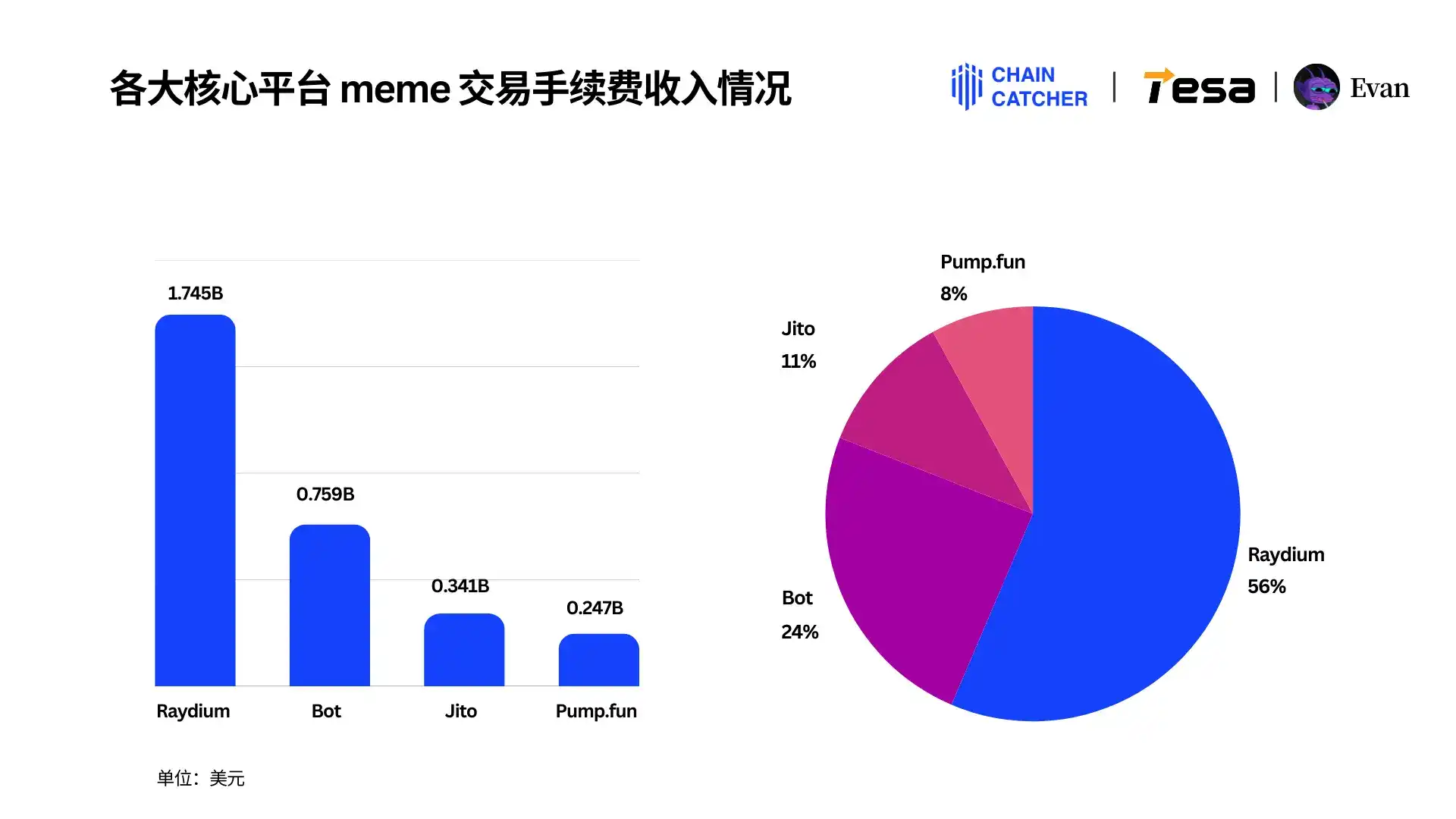
· DEX such as Raydium: Earned $17 Billion in Fees, accounting for 56%.
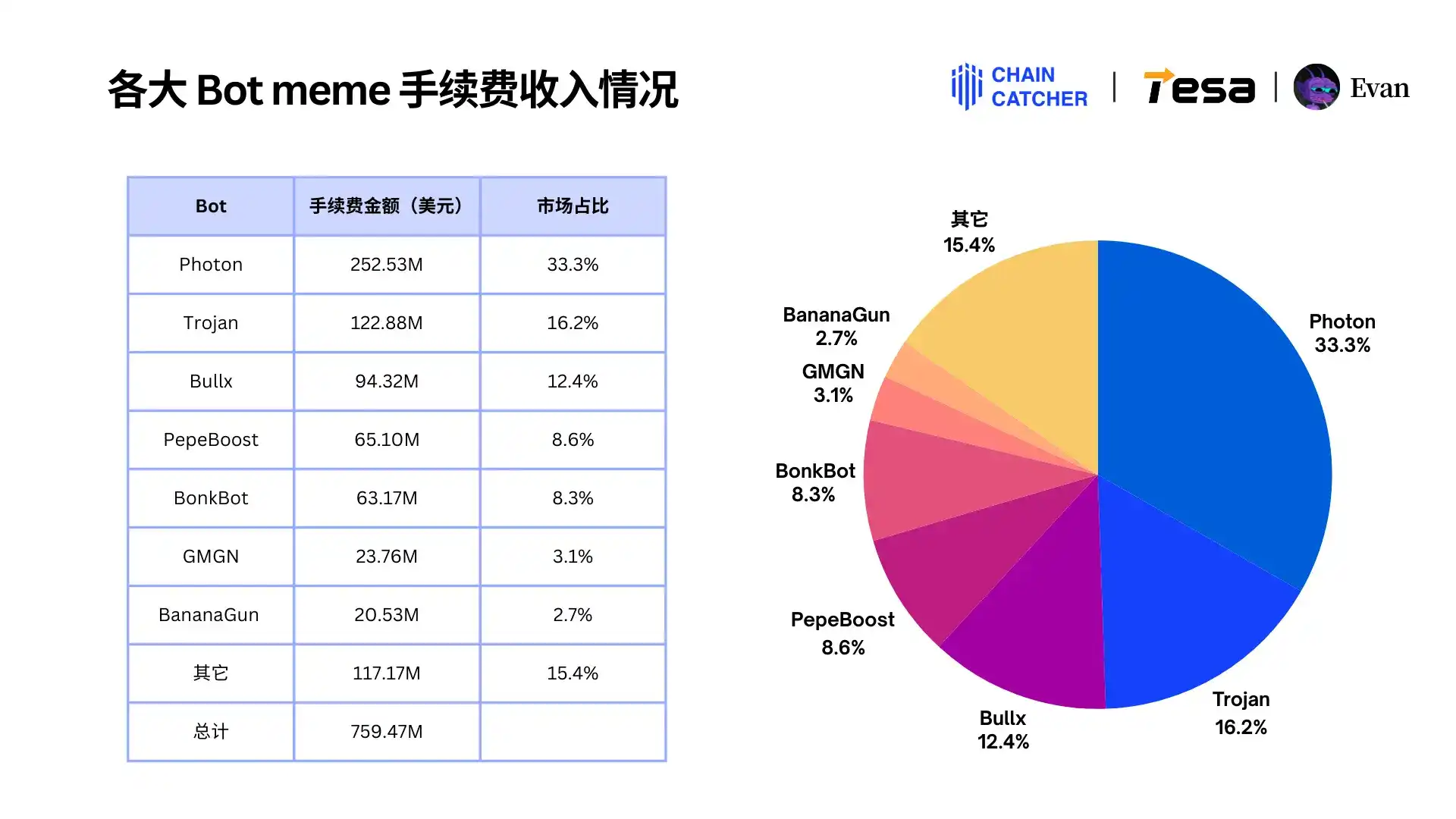
· Trading Bots: Accumulated $7.5 Billion in Fees, representing 24%, with Photon leading with a 33% share.
· MEV Infrastructure Jito: Earned $3.4 billion, accounting for 11%.
· Pump.fun: Earned $2.4 billion, accounting for 8%.
1. User Concentration: The top 10% of users contributed 90% of the fees, with whale users averaging a high consumption of $13,000.
2. Top Users: The largest "whale" on Raydium spent nearly $130 million in a year.
Memecoin Fee Total and Distribution
1. Total Fee Amount Exceeding $30 Billion
As the most popular Memecoin public chain in 2024, Solana's on-chain fee data has become a microcosm of the entire Memecoin market consumption. By analyzing about 4 million Solana user addresses with transaction amounts exceeding $1,000 in 2024, the total fees generated by Memecoin transactions on the Solana chain amounted to a staggering $30.93 billion, demonstrating Solana's dominant position in Memecoin transactions.
2. DEX Raydium and Other DEXs as the Biggest Beneficiaries, Earning Over $17 Billion in Fees
The over $30 billion in fees contributed by Memecoin users mainly flowed to four major platforms: decentralized exchanges (DEXs) like Raydium, trading bots (such as Photon), MEV Infrastructure Jito, and the one-click token issuance platform Pump.fun.
Among them, DEXs like Raydium took the lead with over $17 billion in fee revenue, accounting for 56% of the total, with Raydium alone capturing an 80% share of fees among all DEXs. Trading bots followed with $7.5 billion, representing 24%.
Jito, providing priority transaction (anti-front-running) services, earned $3.4 billion, accounting for 11% due to its exclusive ability. Pump.fun, on the other hand, simplified the token issuance process and gained $2.4 billion, representing 8%.
3. Photon Accounts for Over 33% of Total Transaction BOT Fees and Emerges as the Most Popular BOT
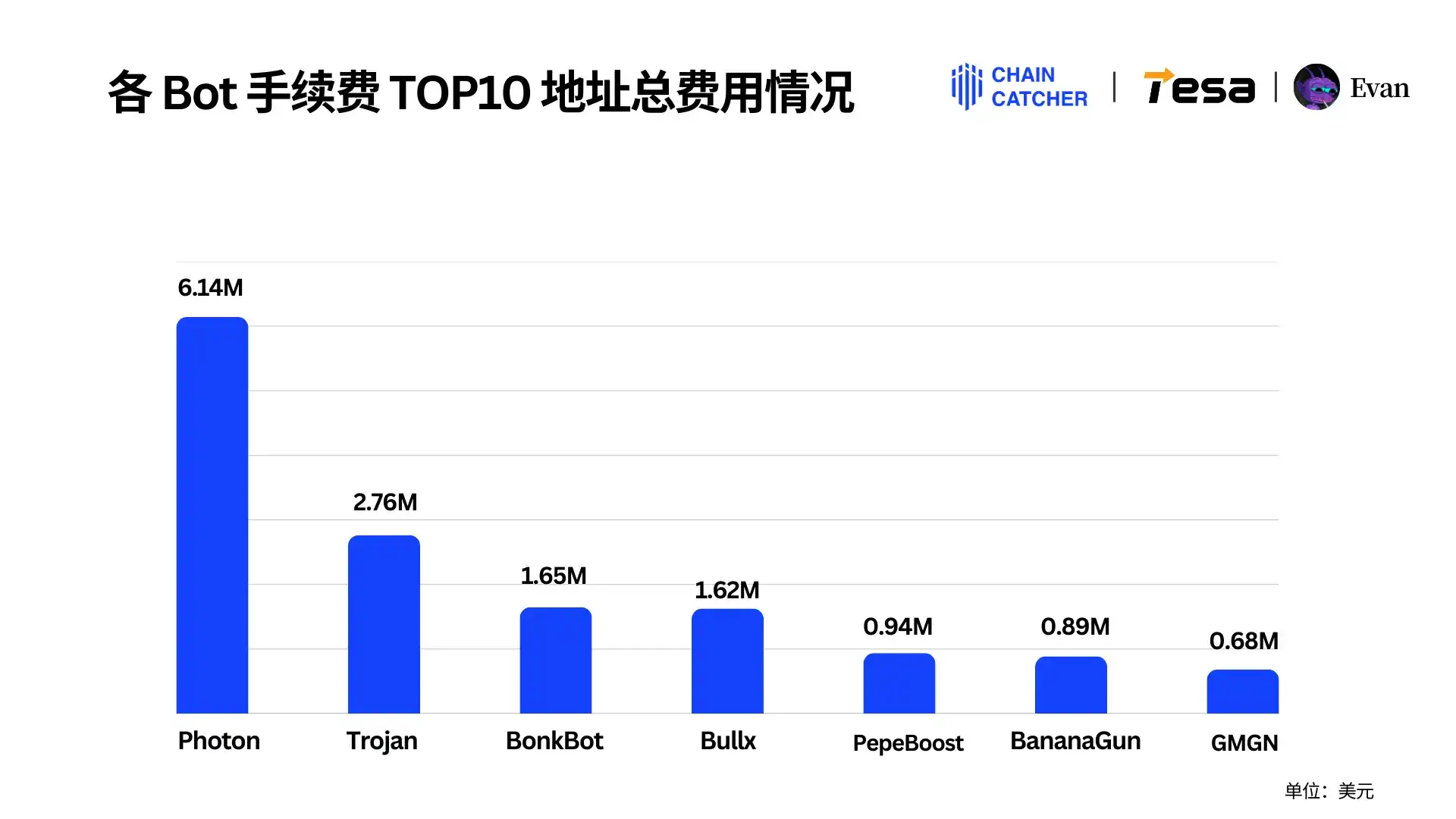
Among various transaction BOTs, Photon stands out by earning a total of $250 million in fees in 2024, representing 33.3% of all transaction BOT fees. Following closely behind are Trojan and Bullx, earning $123 million and over $94 million in fees, accounting for 16.2% and 12.4%, respectively.
Additionally, other BOTs also generated substantial revenue: PepeBoost earned $65.1 million, representing 8.6%; BonkBot earned $63.17 million, representing 8.3%; GMGM and BananaGun earned $23.76 million and $20.53 million, accounting for 3.1% and 2.70%, respectively.
Meanwhile, the data provider of this report, Tesa meme trading platform, offers users a different choice. In contrast to traditional BOTs that charge a 1% transaction fee, Tesa reduces user transaction costs through a subscription model. Furthermore, Tesa has launched the CEX Listing Sniper feature.
4. Whale Users Spent an Average of $13,000 in Transaction Fees for Memecoin Trades in 2024
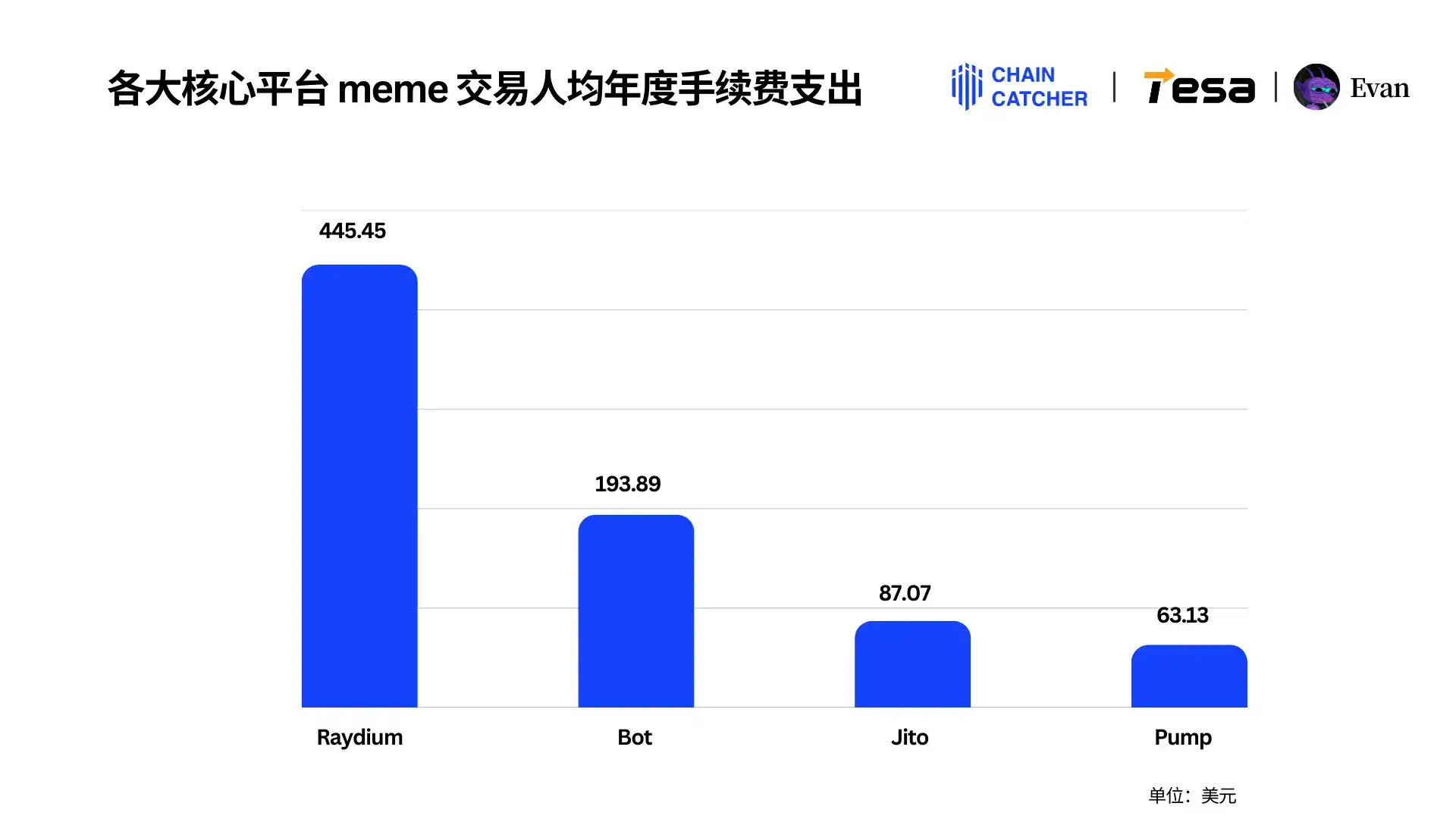
In 2024, Memecoin players showed significant differences in average transaction fee expenditures across major platforms:
· Raydium: $445.45 per user
· Transaction BOT: $193.89 per user
· Jito: $87.07 per user
· Pump.fun: $63.13 per user
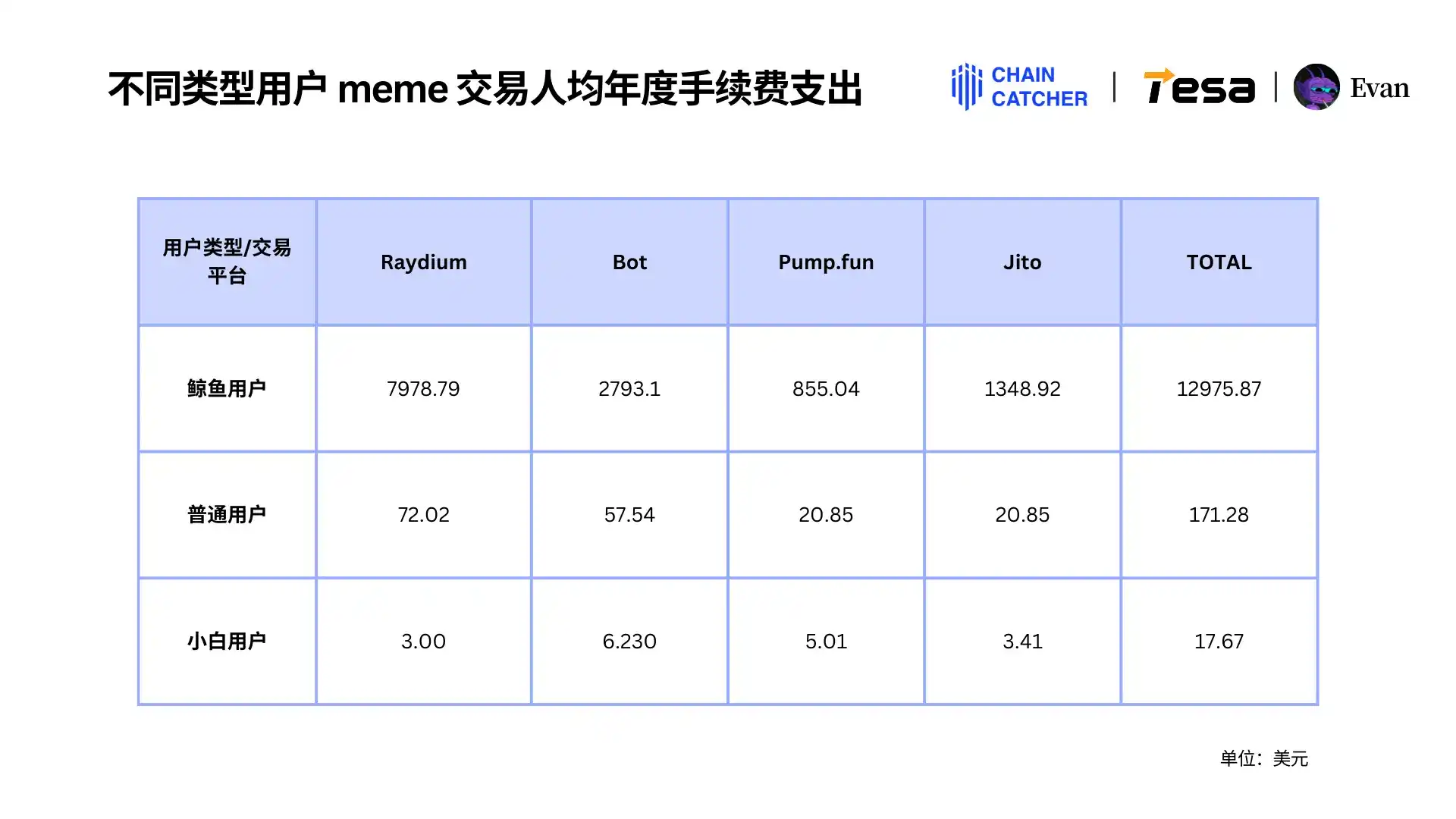
Users are categorized into three groups based on the amount of transaction fees:
1. Whale Users (top 5% highest fees): Avg. annual expenditure as high as $13,000.
2. Regular Users (in the 20%-30% fee range): Avg. expenditure $171.28.
3. Newbie User (25% with the lowest fees): Average spending per person is only $17.67.
In terms of platform preference, Raydium and Trading BOT have become the main fee expenditure places for whale users and regular users, while Newbie Users tend to choose Trading BOT and Pump.fun.
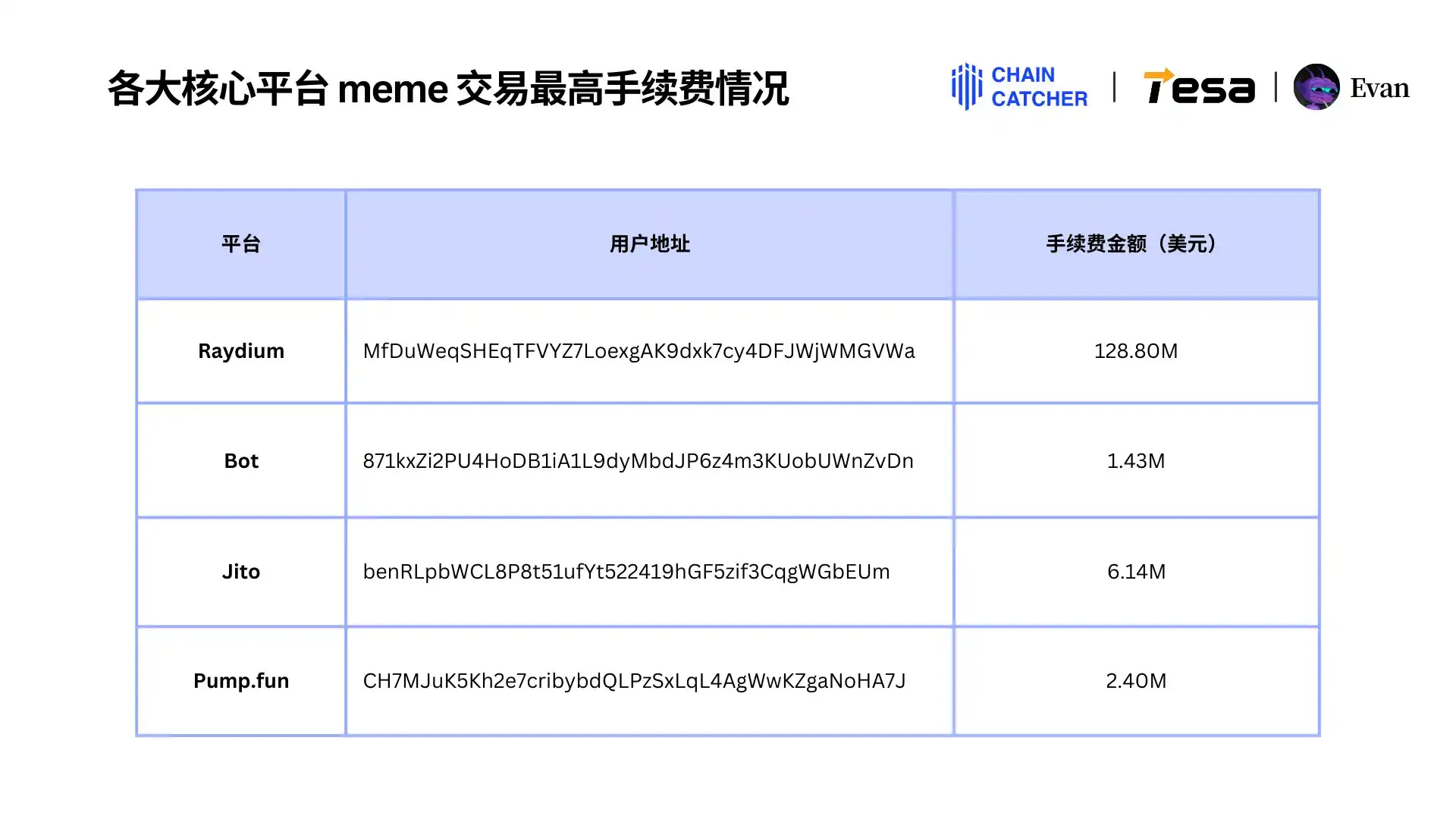
5. The Largest "Whale" User on a Single Platform Spent $129 Million in Fees
In 2024, the Memecoin market saw the emergence of a true "whale" user. Among them, user address MfDuWeq on platforms like Raydium paid a staggering $129 million in fees in one year, far ahead of other platforms.
In contrast, the highest fee expenditures on other platforms were relatively "moderate":
· Trading BOT: $1.43 million
· Jito: $6.1399 million
· Pump.fun: $2.3992 million
This significant difference further highlights Raydium's dominant position in the Memecoin trading market.
II. Memecoin User Expenditure Concentration and Cross-Platform Characteristics
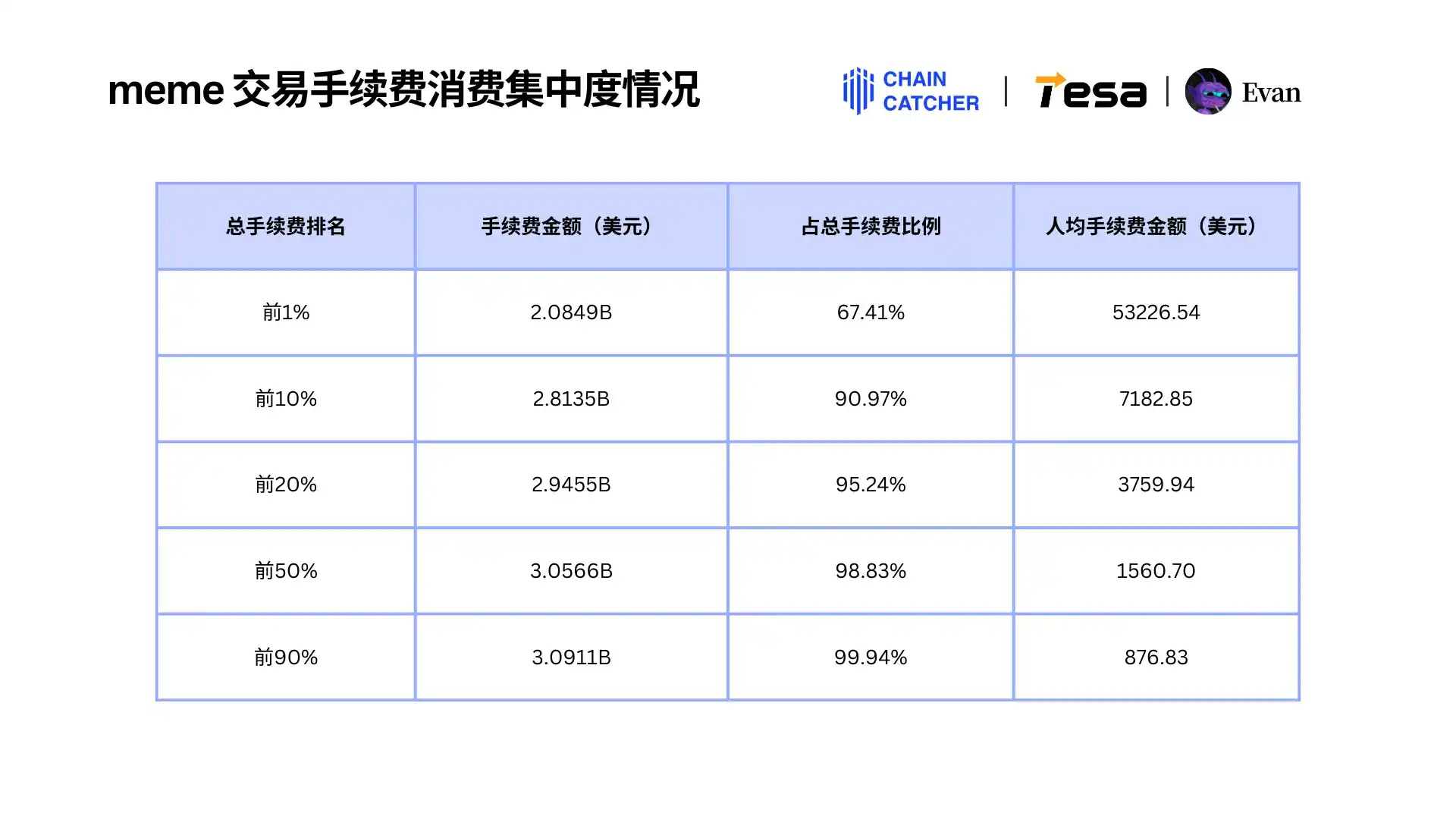
1. Top 10% of Users by Spending Contribute Over 90% of Fees
Memecoin users' spending behavior exhibits a clear "80-20 rule": a few top users contribute the majority of fees. The specific data is as follows:
· The top 1% of users contributed 67.46% of the fees, with an average fee amount of $53,000 per person;
· The top 10% of users contributed 90.97%, with an average fee amount of around $7,182 per person;
· The top 20% of users contributed 95.24%. The average fee amount per person is approximately $3,760.
This high level of consumption concentration indicates that the fee income in the Memecoin market mainly relies on a small number of high-spending users, while the fee expenditure of the majority of regular users is relatively low.
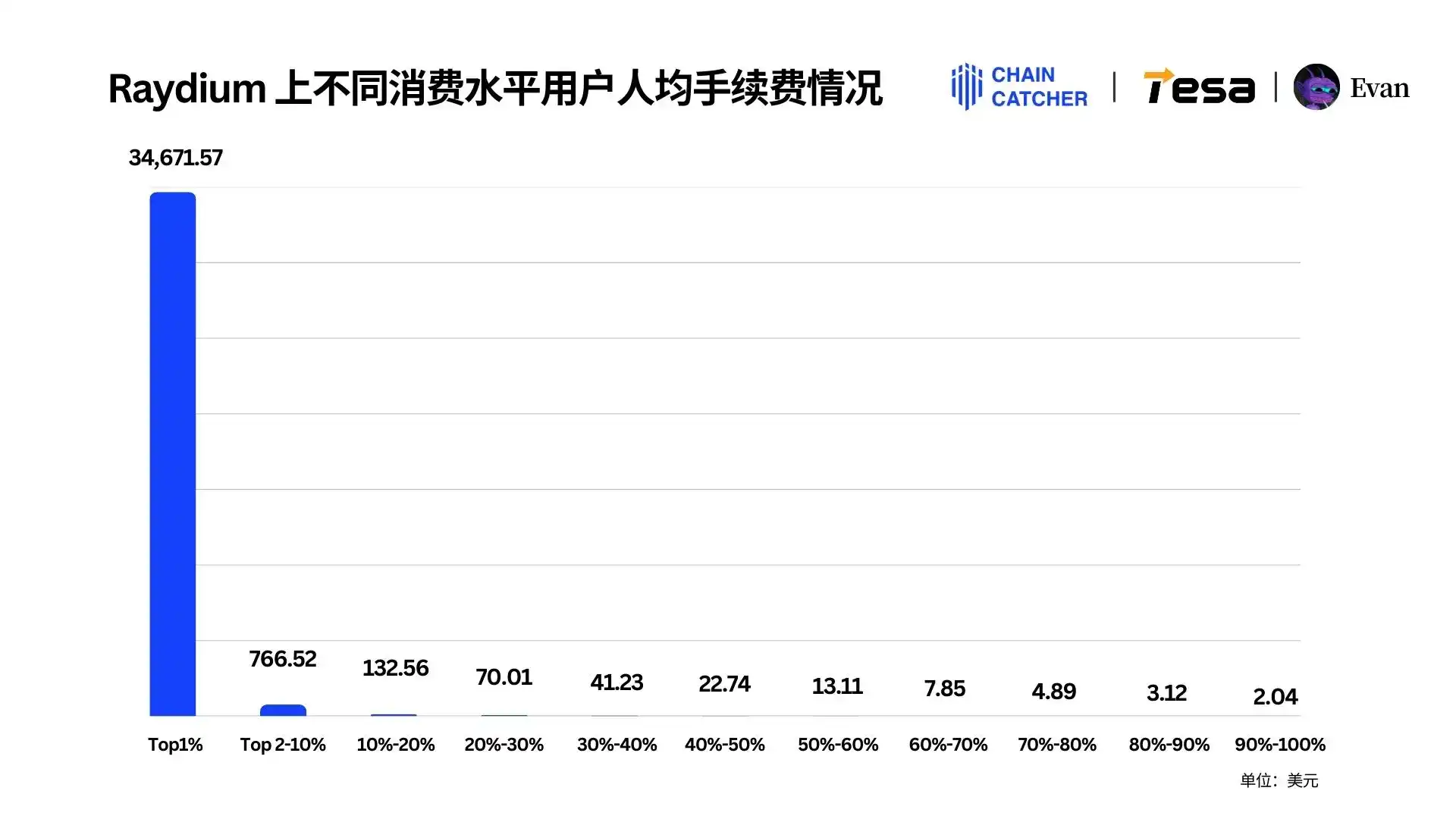
2. Raydium has the highest consumption concentration, Pump.fun relatively lower
Among Raydium, Trading BOT, Jito, and Pump.fun, Raydium has the highest consumption concentration. Data shows that the top 1% of users contributed $1.358 billion in fees, accounting for 79.88% of the total $1.7 billion in fees, with an average fee per person reaching $34,700; while the average fee per person for users ranking in the 2-20% range is below $800, and the long-tail users ranking beyond 20% have an average fee per person of less than $100. This also reflects Raydium's high dependence on top users.
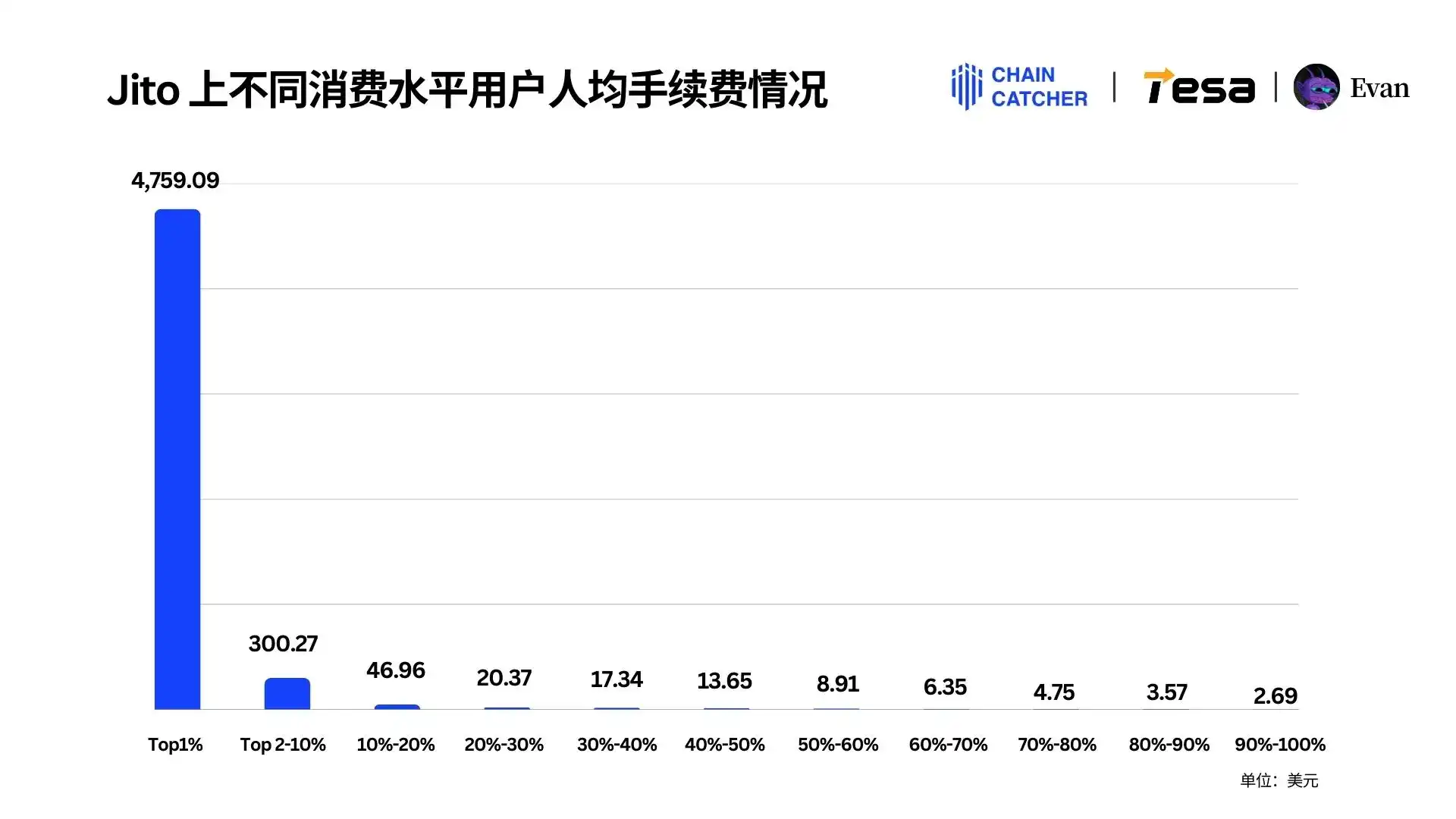
In contrast, for Jito, the top 1% of users in fee ranking contributed $186 million in fees, accounting for 54.55%, although the concentration is lower than Raydium, it still exceeds half. There is also a significant difference in the average fees between Jito's top users and long-tail users, with the top 1% of users around $4,759, while users in the 2%-10% range drop to $300, and long-tail users ranking beyond 10% have an average fee per person of less than $50.
The consumption concentration at the top end for Trading BOT and Pump.fun is relatively lower:
· Trading BOT: The top 1% of users contributed $313 million, accounting for 41.24%.
· Pump.fun: The top 1% of users contributed $96.62 million, accounting for 39.07%.
This difference indicates that different platforms have significant differences in user structure and profit models.
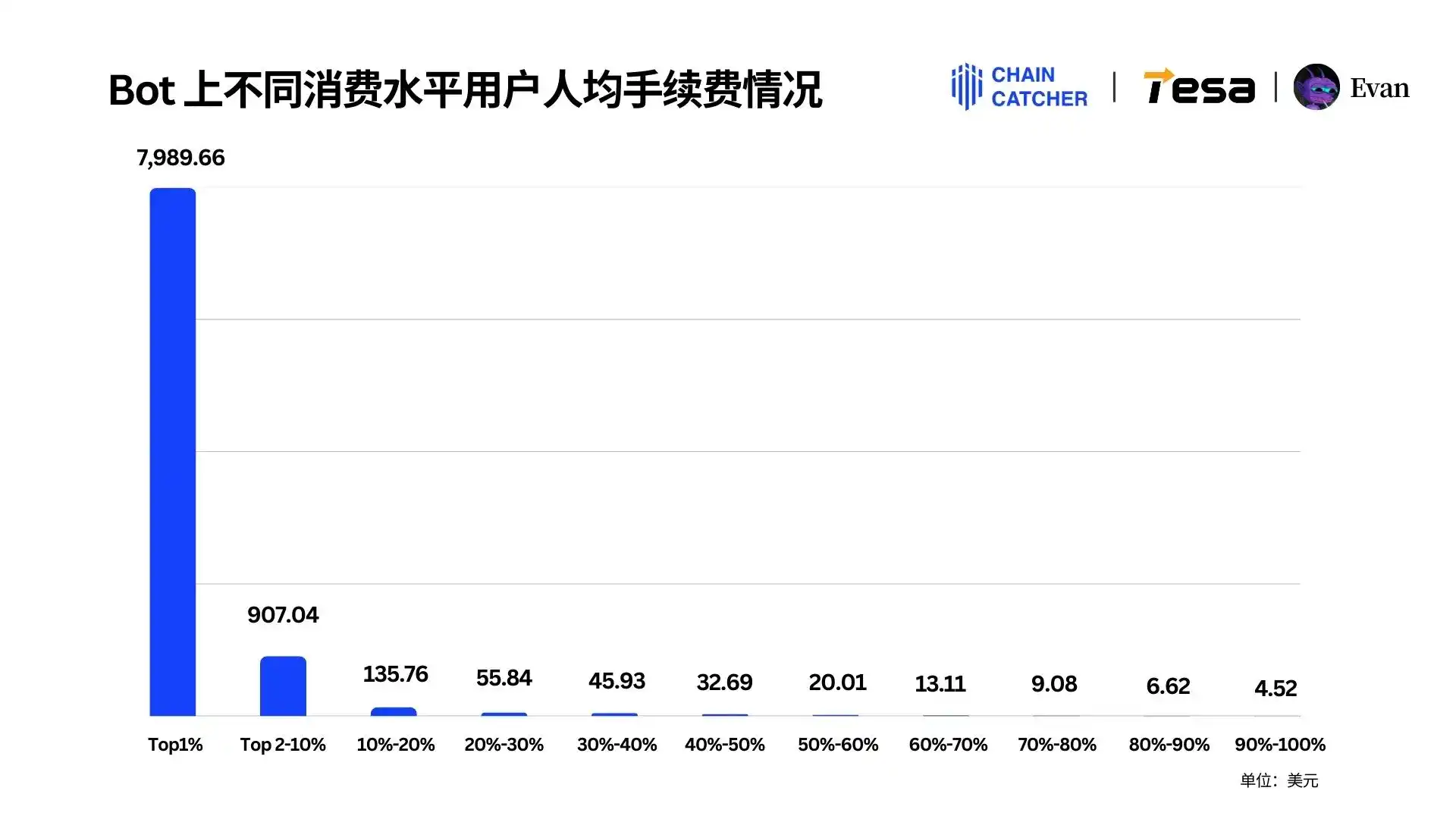
In terms of average fees per person, there is also a significant difference between top users and long-tail users on Trading BOT and Pump.fun. The top 1% of users on Trading BOT have an average fee per person of $7,990, while users in the 2%-10% range are less than $1,000, and users beyond the 20% range are all below $60.
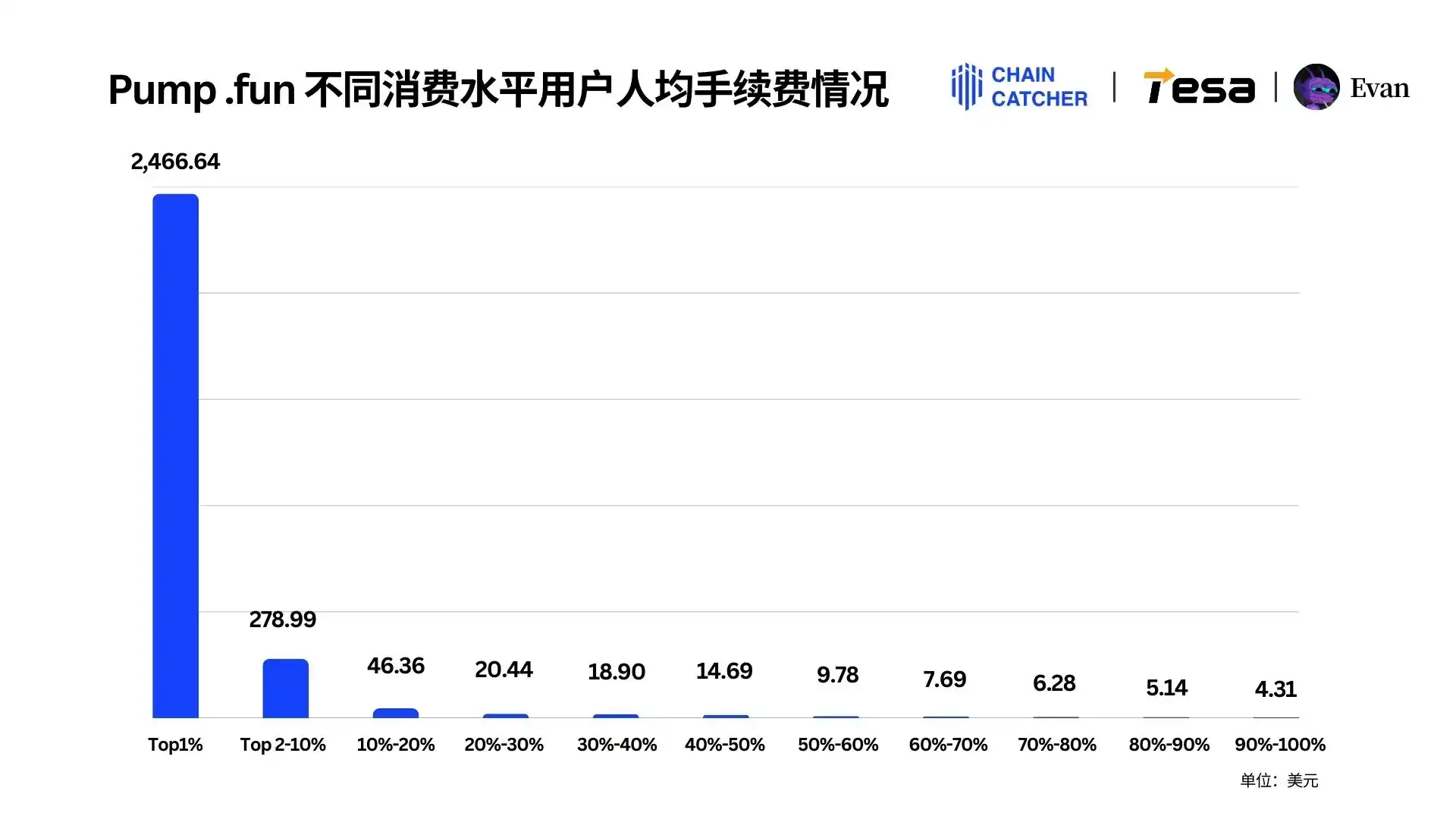
The average fee per user in the top 1% on Pump.fun reached $2467, while users ranked 2%-10% paid less than $300, and those ranked after 20% paid less than $50.
3. Raydium Has the Highest Utilization Rate, with Over Half of Users Relying on Trading Bots
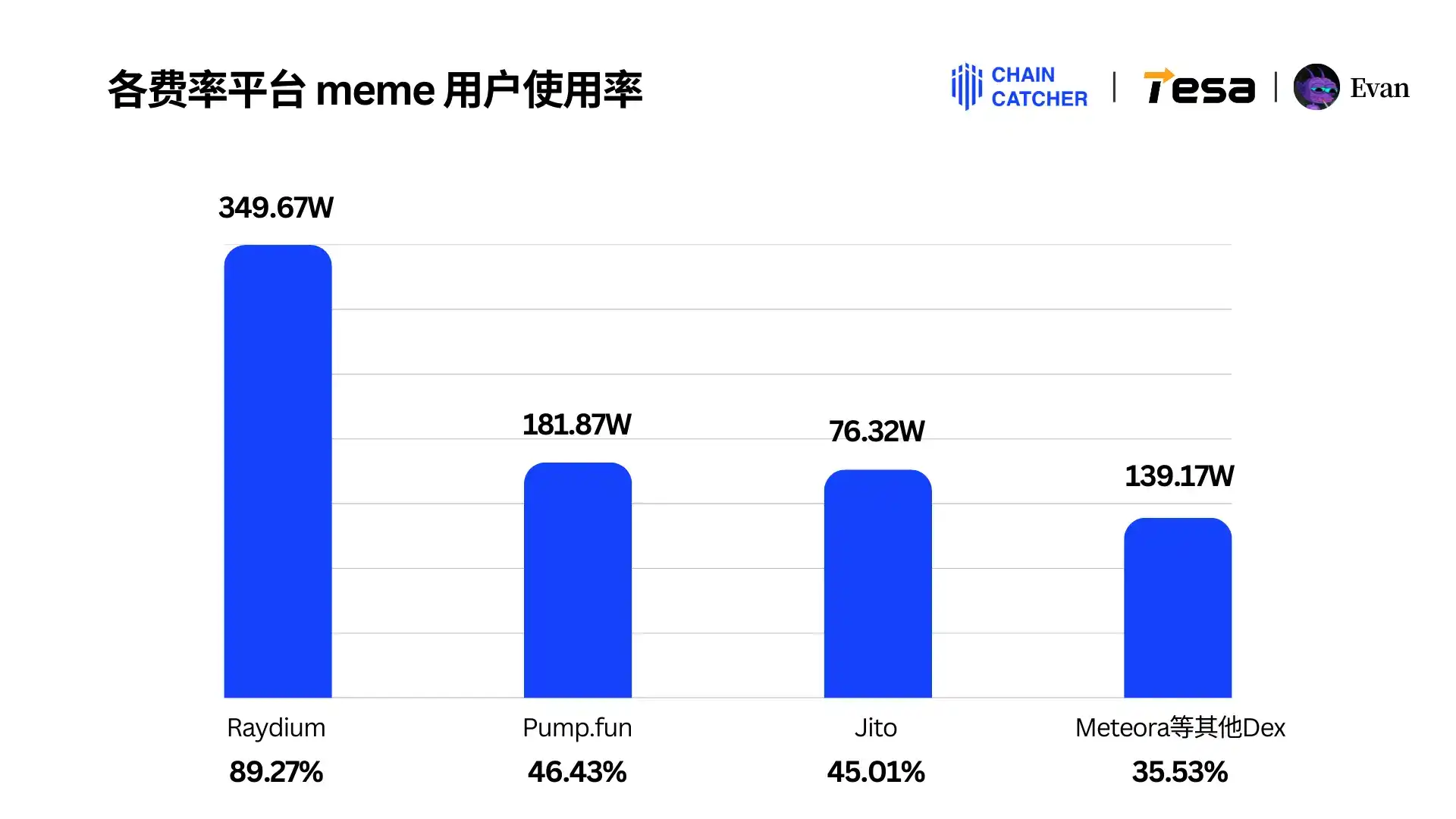
Within the Solana DEX ecosystem, despite Raydium's higher transaction fee (0.25%) compared to Meteora's (0.16%), Raydium still attracts the vast majority of users due to its strong market dominance. Statistical data shows:
· Out of approximately 4 million Solana addresses, around 89.27% (3.4968 million addresses) have used Raydium.
· In contrast, the total utilization rate of Meteora and other DEXs is only 35.53% (1.3917 million addresses).
This phenomenon indicates that Memecoin users, when choosing a trading platform, do not solely consider fees but also value factors such as liquidity, user experience, and platform stability.
Furthermore, the use of trading bots is also widespread:
· Over 2.11 million addresses utilize trading bots, with a usage rate of 53.83%.
· In comparison, the utilization rates for Pump.fun and Jito are 46.43% and 45.01%, respectively, still below the halfway mark.
These data reflect users' high reliance on efficient and convenient trading tools, while also showcasing Raydium's absolute market dominance.
4. Over Half of Bot Users Use Only a Single Bot Platform
Within the trading bot market, user choices exhibit noticeable concentration. The data shows:
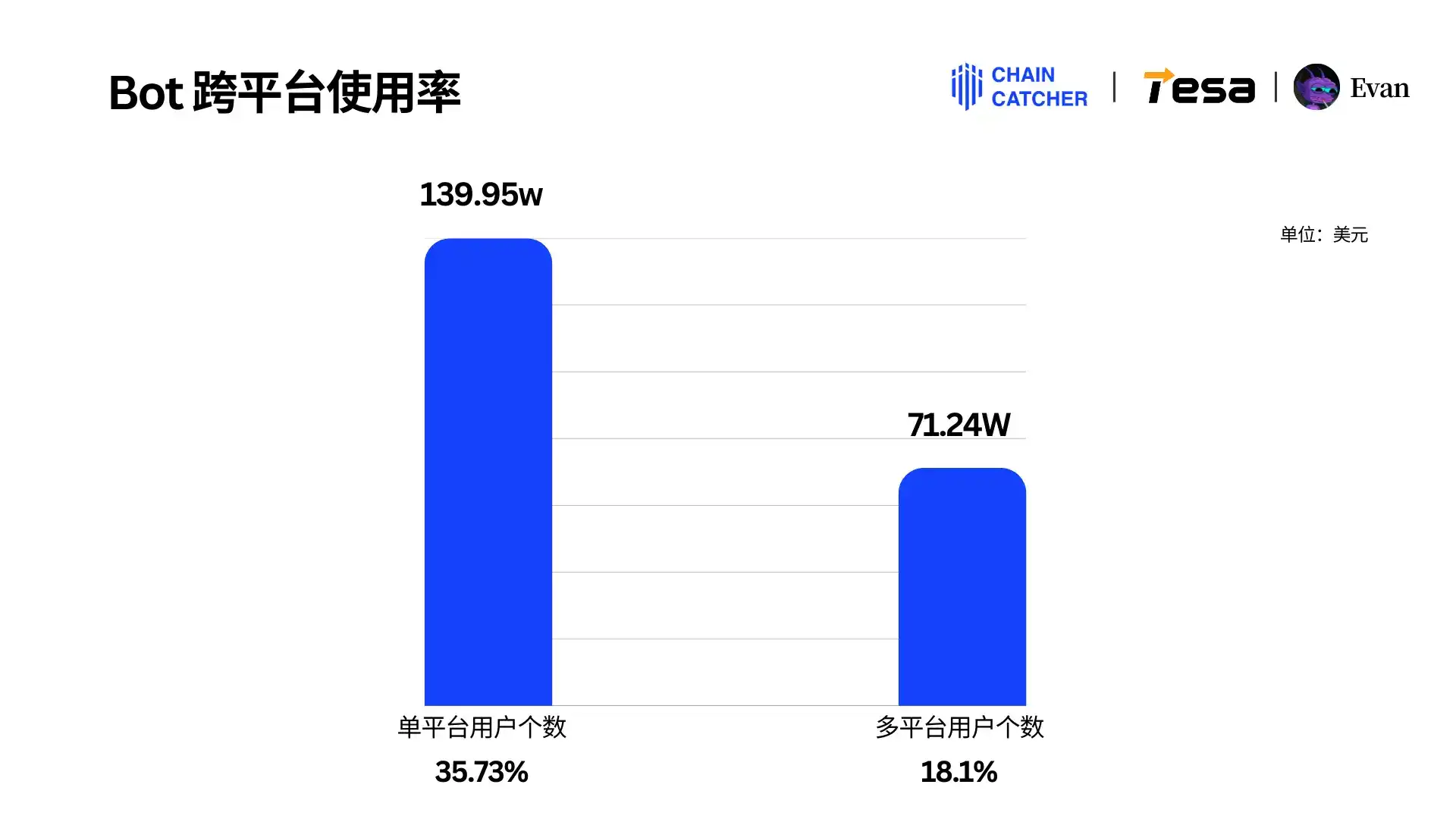
· 66% (1.3995 million) of bot user addresses use only a single trading bot.
· 34% (712,400) of users choose to use multiple BOT trades.
This percentage indicates that users have high loyalty to the selected BOT platform, or due to the lack of significant differentiation between platforms, users, once they choose a BOT, lack the motivation to switch or engage in multi-platform trading.
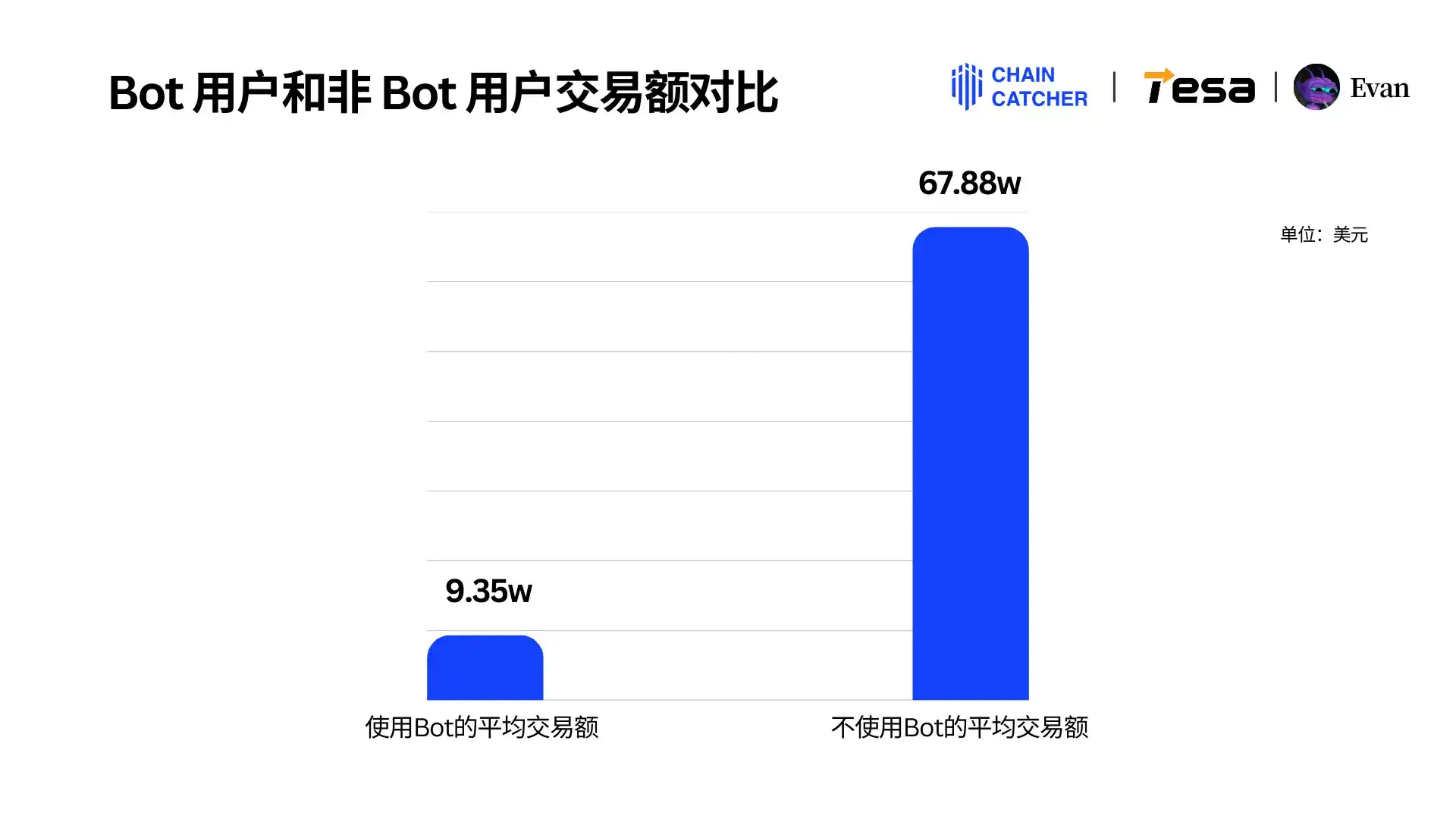
5. Users Not Using BOTs Have Significantly Higher Transaction Volume
Compared to users using trading BOTs, users not using BOTs have an average transaction volume several times higher:
· Users using BOTs: Average transaction volume is $93,500.
· Users not using BOTs: Average transaction volume reaches $678,800.
This data may reflect that the BOT user group consists mainly of regular users and newbies, while high-volume whale users tend to prefer manual operation or use efficient tools to seek more precise control.
6. Whale Users Prefer Photon, Regular Users Lean Towards Trojan
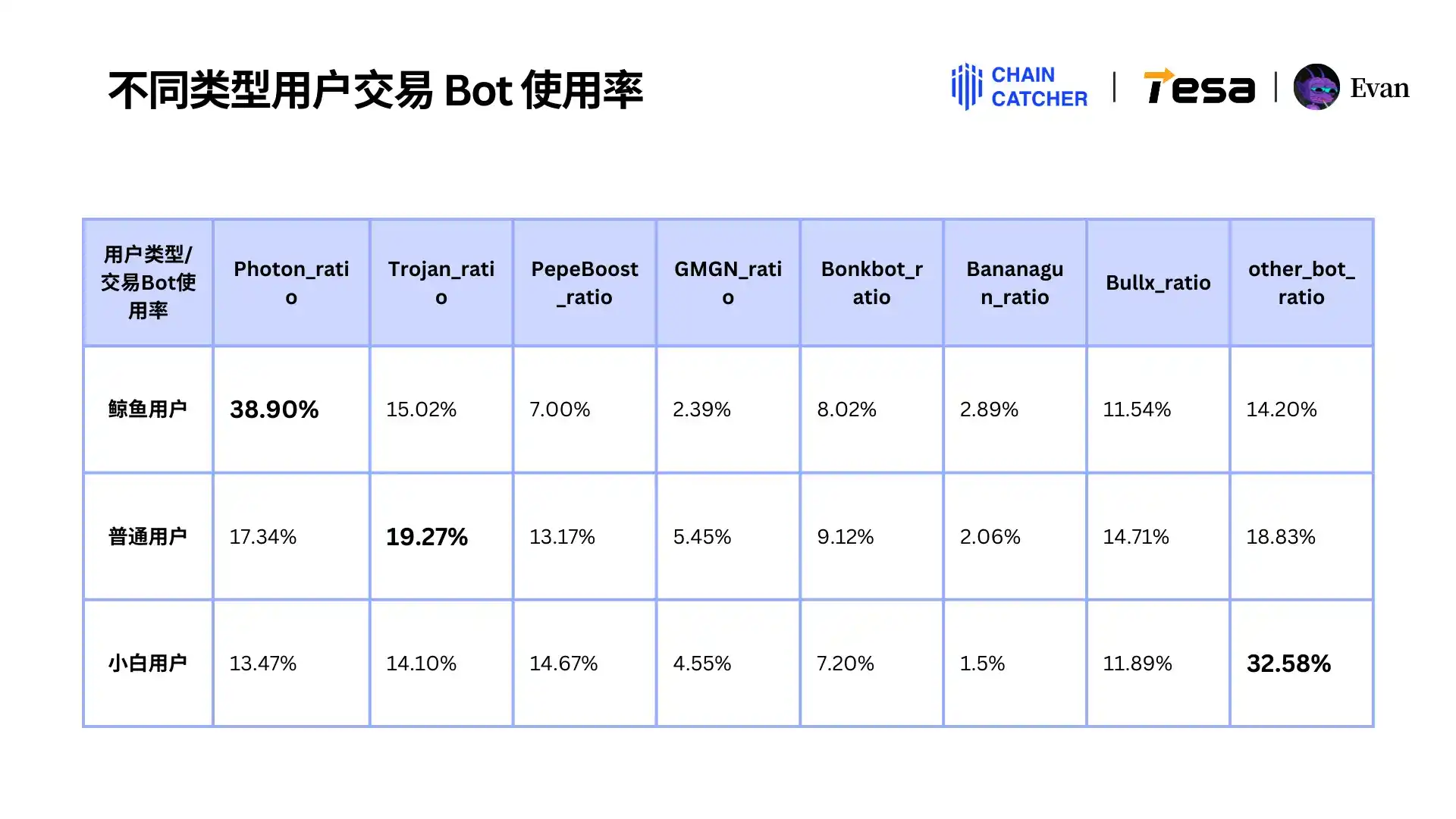
Users with different spending levels show significant differences in choosing trading BOTs:
Whale Users (Top 5%)
· Photon is the most popular trading BOT, contributing 38.9% of transaction fees.
· Trojan follows closely, with a share of 15.02%.
This choice indicates that whale users prefer to use the powerful and stable Photon BOT.
Regular Users (Ranked 20%-30%)
· Trojan is the top choice for regular users, accounting for 19.27% of total transaction fees.
· Photon and Bullx rank second and third with 17.34% and 14.71%, respectively.
The choice of regular users is becoming more diverse, demonstrating widespread acceptance of different BOT features.
Newbie Users (Bottom 25%)
· The choice of newbie users is relatively dispersed, with Trojan, Photon, PepeBoost, and Bullx being the main trading BOTS, each contributing over 10% of the fees.
This distribution reflects that newbie users tend to try out multiple tools when using BOTS, rather than concentrating on a single platform.
III. 2024 Memecoin Annual Consumption TOP 10 Address Analysis
1. 5 Addresses with Fees Exceeding Ten Million Dollars, with the Highest Spending Reaching 133 Million Dollars
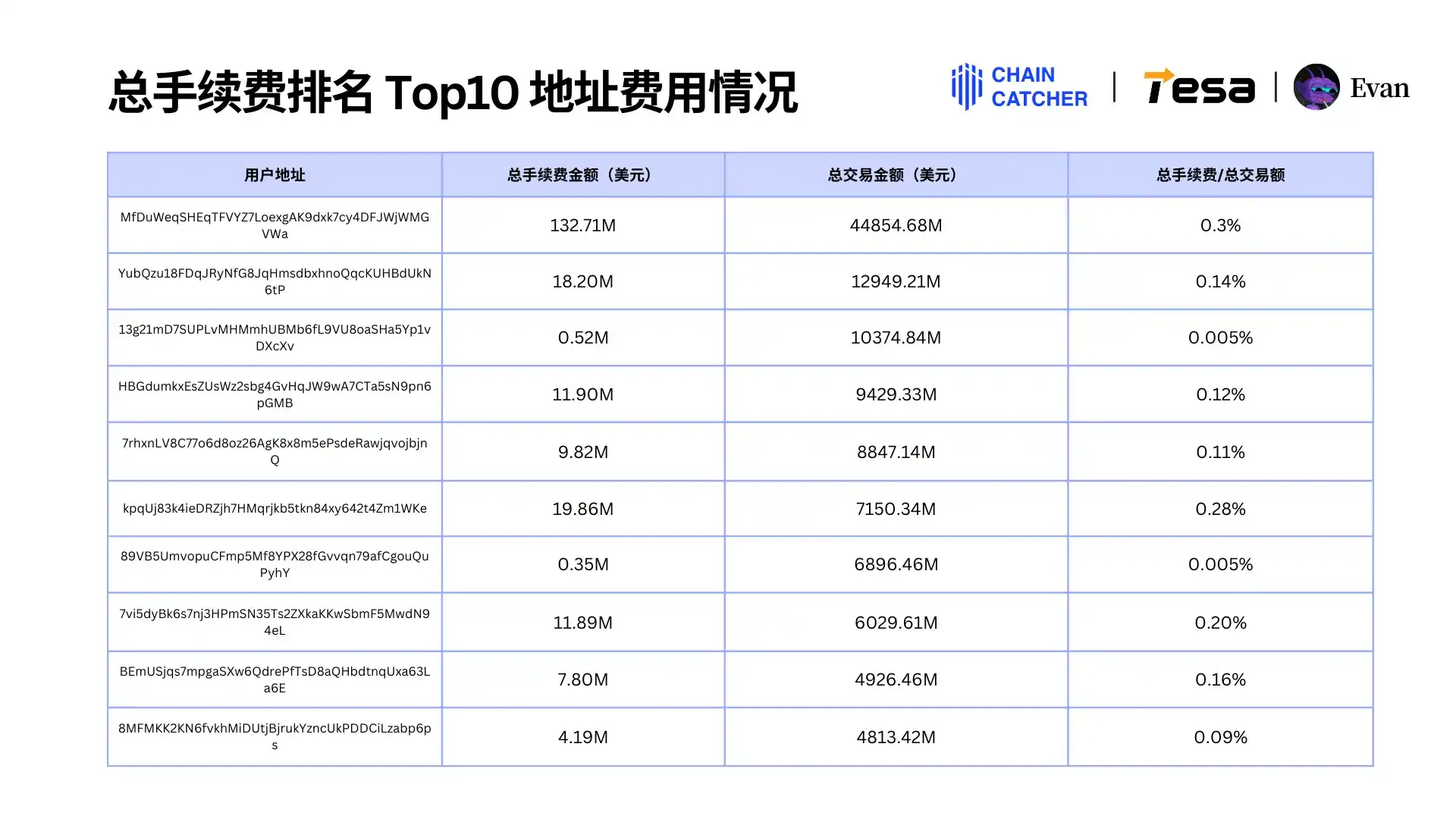
In the 2024 Memecoin transactions, the total fees of the Top 10 user addresses show a high level of consumption concentration, with 5 addresses having total fees exceeding 10 million dollars:
· MfDuWe: 133 million dollars (Fee Rate 0.3%, Total Transaction Amount 448.55 billion dollars).
· kpqUj8: 19.86 million dollars.
· YubQzu: 18.2 million dollars.
· HBGdum: 11.9 million dollars.
· 7vi5dy: 11.89 million dollars.
2. Comparison of Highest and Lowest Fee Users
· The address with the highest fee, MfDuWe, demonstrates a large transaction volume and expenditure, with its fee representing 0.3% of the total transaction amount.
· In contrast, the fee rates of addresses 13g21m and 89VB5U are only 0.005%, the lowest level.
This data clearly reflects the consumption difference among different users in the Memecoin market, as well as the significant contribution of top users to the overall fee revenue.
3. Total Fee Amount from Top 10 Addresses on Platforms such as Raydium, Jito, Pump.fun
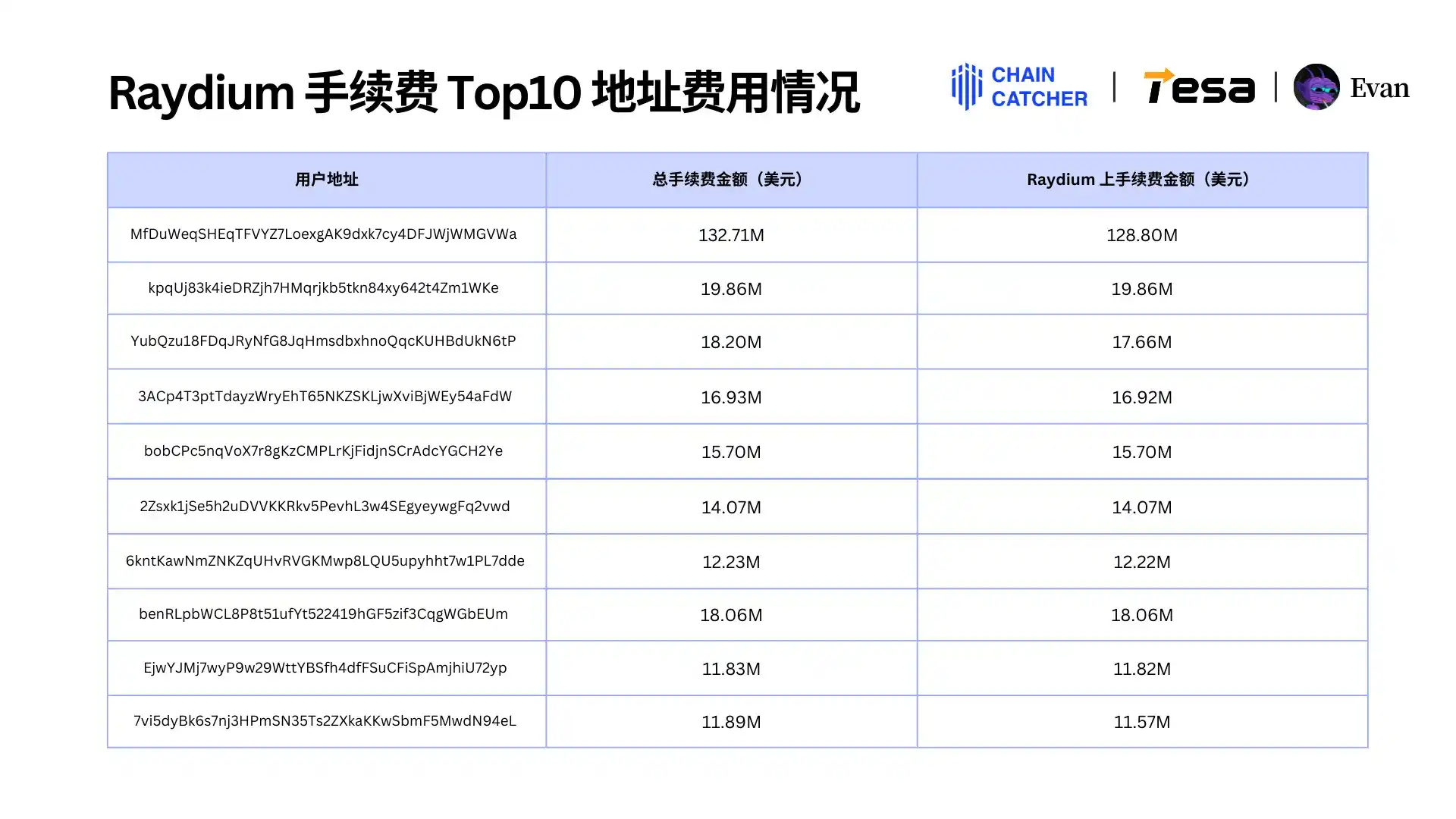
The Top 10 user addresses on the Raydium platform show a high fee contribution, with each address's annual fee spending exceeding $10 million. These users almost entirely concentrate all fee spending on the Raydium platform. Details of the Top 10 addresses:
For Jito, the fee amounts from the Top 10 addresses range from $1.2 million to $6.2 million. Details of the Top 10 addresses:
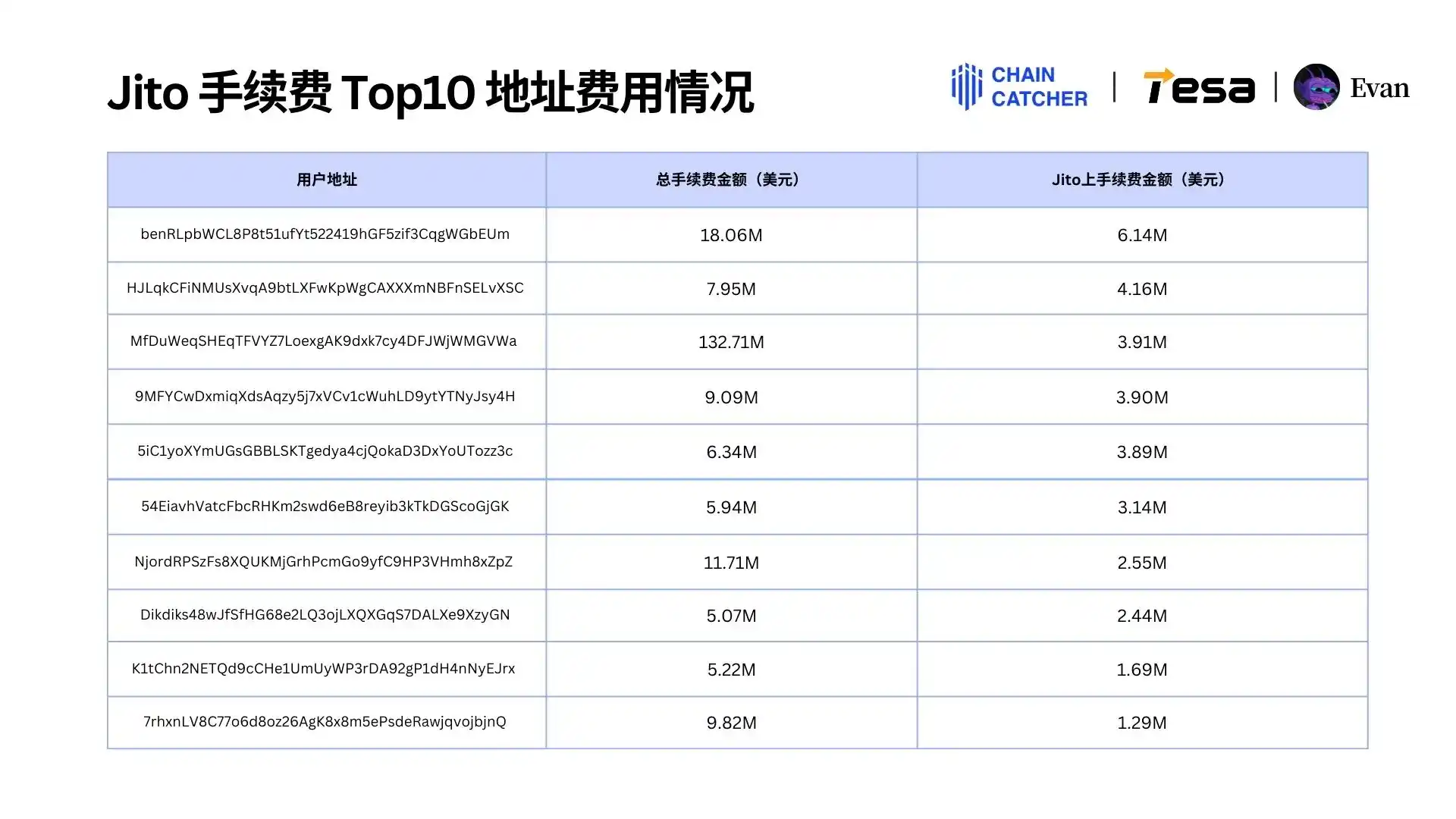
For Pump.fun, the fee amounts from the Top 10 addresses range from $500,000 to $2.4 million. Details of the Top 10 addresses:
4. Total Fee Details of Various Bot Fee Top 10
4. If you need to check your personal 2024 Memecoin spending statement, please refer to:
https://report.tesa.top/
You may also like

Morning Report | OpenAI has submitted an S-1 registration statement draft to the U.S. SEC; Morpho completes $175 million financing

Galaxy Deep Research Report: How Hyperliquid's HIP-4 Upgrade Changes the Landscape of Prediction Markets?

Latest research from 13 top universities including Cornell University: The current state, challenges, and misconceptions of the fusion of Crypto and AI

Deconstructing Anthropic: The Best AI Company, Possibly Also a Type of Organizational Invention

Every exchange is a "Universal Exchange."

The counterattack of traditional finance: Alliance chains are quietly reviving
Pantera Capital Partner: How Tokenization is Restructuring the Private Equity and Early Investment Ecosystem?

Mastercard Launches Agent Pay for AI, Plans to Record AI Agent Payment Authorizations on Polygon
Mastercard launched Agent Pay for AI, a new payment protocol designed to help AI agents make small payments such as pay-per-use access to data and APIs. The system plans to record human-granted AI agent permissions on Polygon, focusing on verifiable authorization, identity, and payment controls.

Curve Deploys Llamalend v2 on Optimism With 250,000 OP Incentives
Curve launched Llamalend v2 on Optimism with 250,000 OP incentives from the Optimism Foundation. The upgrade expands Llamalend beyond its earlier crvUSD-focused model, adding broader collateral support, LlamaRisk market reviews, and the ability to use Curve LP tokens as collateral.

Raydium Old Liquidity Pool Reportedly Exploited, With $1.34 Million Moved to Ethereum and Tornado Cash
An old Raydium liquidity pool was reportedly exploited for around $1.34 million in USDC, RAY, and wSOL, with the stolen funds bridged to Ethereum and deposited into Tornado Cash. The incident highlights the tail risks of legacy DeFi pools, old contracts, and cross-chain fund laundering paths.
Kalshi Executive Challenges “SBF Backed AI Unicorns” Narrative, Says Leopold Aschenbrenner Was Key Figure
Kalshi executive John Wang questioned the “SBF backed AI unicorns” narrative, saying Leopold Aschenbrenner was the key figure behind major AI investment decisions.

New York Proposes Stricter Stablecoin Issuer Rules Aligned With Federal GENIUS Act
NYDFS proposed stricter stablecoin issuer rules aligned with the GENIUS Act, covering reserves, custody, redemption timelines, audits, and capital buffers.

CryptoQuant Says Bitcoin Profitable Supply Is Near 45% Pressure Zone as On-Chain Data Points to Market Repricing
CryptoQuant said Bitcoin’s profitable supply is nearing the 45% pressure zone, signaling rising market stress, unrealized losses, and a possible on-chain repricing phase.

Bitcoin Falls Below 200-Week Moving Average as On-Chain Data Shows Over Half of Supply in Loss
Bitcoin dropped below its 200-week moving average as on-chain data showed over 50% of circulating supply is now in loss, signaling rising market stress.

CFTC Reportedly Plans New Prediction Market Rules Focused on Manipulation Risk and Public Interest Review
The CFTC is reportedly preparing new prediction market rules focused on manipulation risk, public interest review, and retail trader protections.

Meet the new WEEX trial fund—your gateway to greater profits

WEEX Labs Lands at Dutch Blockchain Week: A Disruptive Crypto × AI Conversation Sets Sail in Amsterdam
SK Hynix Reportedly Plans U.S. ADR Listing as Early as August, With SEC Approval Possible in Late June
SK Hynix may pursue a U.S. ADR listing as early as August, with SEC approval reportedly possible in late June amid strong AI chip supply chain demand.
Morning Report | OpenAI has submitted an S-1 registration statement draft to the U.S. SEC; Morpho completes $175 million financing
Galaxy Deep Research Report: How Hyperliquid's HIP-4 Upgrade Changes the Landscape of Prediction Markets?
Latest research from 13 top universities including Cornell University: The current state, challenges, and misconceptions of the fusion of Crypto and AI
Deconstructing Anthropic: The Best AI Company, Possibly Also a Type of Organizational Invention
Every exchange is a "Universal Exchange."
The counterattack of traditional finance: Alliance chains are quietly reviving


