
200 Million Gasless Transactions in One Month, Is Account Abstraction a Trend or a Bubble?

Original Article Title: The Real State of Gasless Web3
Original Article Author: Stacy Muur, Cryptocurrency Researcher
Original Article Translation: DeepSeek
Editor's Note: The article summarizes that within 30 days, 89 projects on 9 blockchains achieved over 2 million gasless transactions through ERC-4337 smart wallets, saving approximately $11,700 in gas fees, demonstrating the significant potential of the Paymaster payment model to enhance on-chain activity. However, the surge in transaction volume may mask the true user demand, as one-time activities such as NFT minting and airdrops lead to a short-term spike in wallet numbers but with low retention rates, while a few games, DeFi, and infrastructure apps show deeper levels of reuse. Data indicates that while Gas sponsorship can attract users, sustained engagement relies on attractive applications. ERC-4337 has driven the mainstream adoption of gasless transactions but faces technical complexity and cost challenges. The future EIP-7702 is expected to further simplify and expedite its adoption.
The following is the original content (slightly reorganized for better readability):
Within a mere 30 days, 89 projects on 9 blockchains facilitated over 2 million gasless transactions, saving up to $11,700 in gas fees.
The wave of gasless transactions across multiple chains indicates that solutions like those in ERC-4337 smart wallets, where fees are paid by Paymasters, can rapidly boost on-chain activity.
Paymaster-Driven Adoption May Mask True User Demand
· The surge in transaction volume may not necessarily reflect genuine user interest, especially when a small number of wallets (such as traders, bots) repeatedly call contracts.
· One-time airdrops, free minting, or claiming activities may lead to a short-term spike in wallet numbers, but subsequent usage rates are extremely low.
New wallet numbers for NFTs, games, and token projects have seen a surge, but many wallets are used only for one-off operations (such as minting or claiming rewards) rather than ongoing engagement.
On the other hand, a few applications have demonstrated deeper, repetitive usage, typically driven by more engaging game loops, repetitive DeFi actions, or infrastructure-level services.
These findings indicate that ERC-4337 smart wallets are reshaping on-chain activity, showcasing both the power of Gas sponsorship to attract users and the need for attractive, reusable applications to maintain user engagement.
@0xKofi has built an authoritative dashboard to track this explosive growth, with data provided by @base.
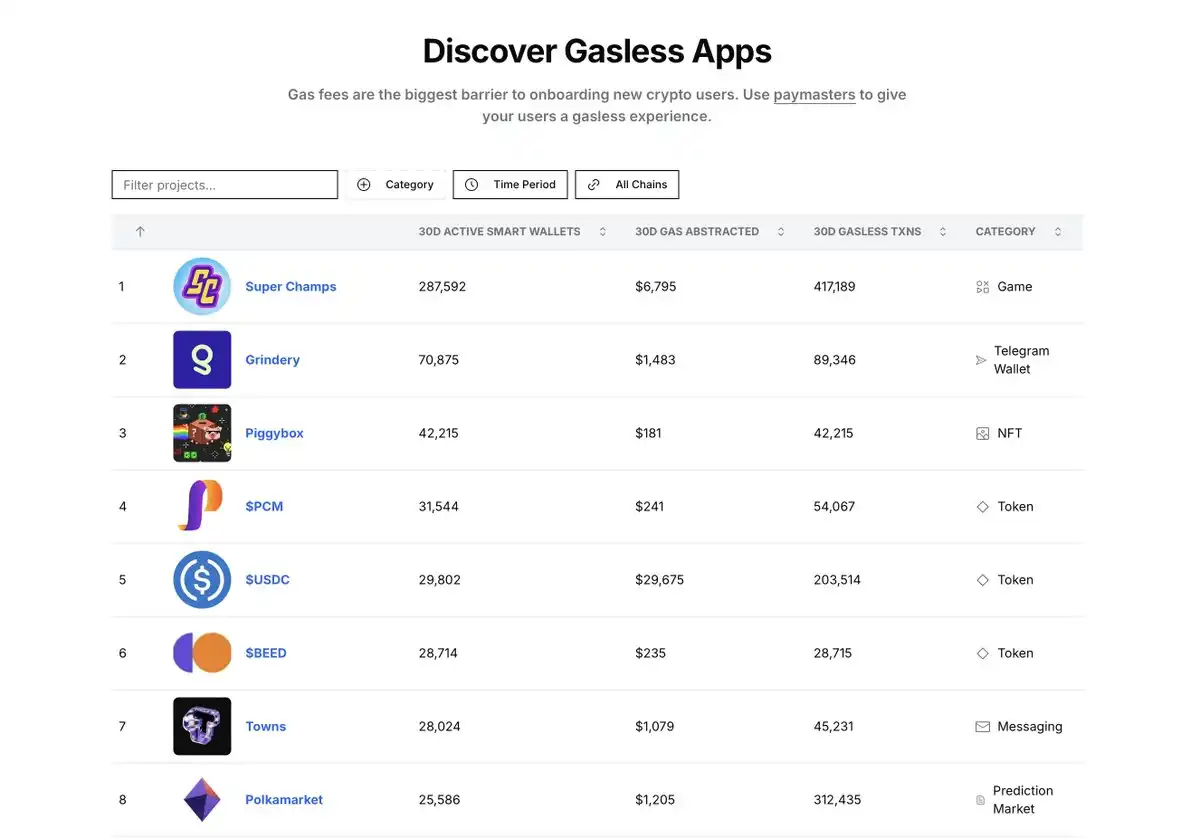
Key Metrics
· 89 unique apps/protocols
· Approximately 724,000 active smart wallets
· Approximately $11,700 waived in Gas fees
· Approximately 2,087,799 Gasless transactions
Development of ERC-4337
The rapid growth of Gasless transactions is part of a larger trend. In 2024, ERC-4337 accounts executed over 103 million User Operations (UserOps), more than 10 times the 8.3 million in 2023. 87% of these transactions had their fees paid by Paymasters, enabling a Gasless experience.
From the monthly Paymaster Gas expenditure chart, we can observe the following evolution:
· Early Adoption (2023): Little expenditure before mid-2023, with Optimism leading the early adoption.
· Growth Phase (Late 2023): By October 2023, monthly expenditure steadily increased to around $400,000.
· Peak Activity (April 2024): Expenditure surged to around $700,000, primarily driven by Base.
· Recent Trends (Late 2024 to Early 2025): After reaching a new high in November to December 2024 (around $630,000), monthly Gas expenditure has significantly dropped in early 2025, down to around $150,000 in February.
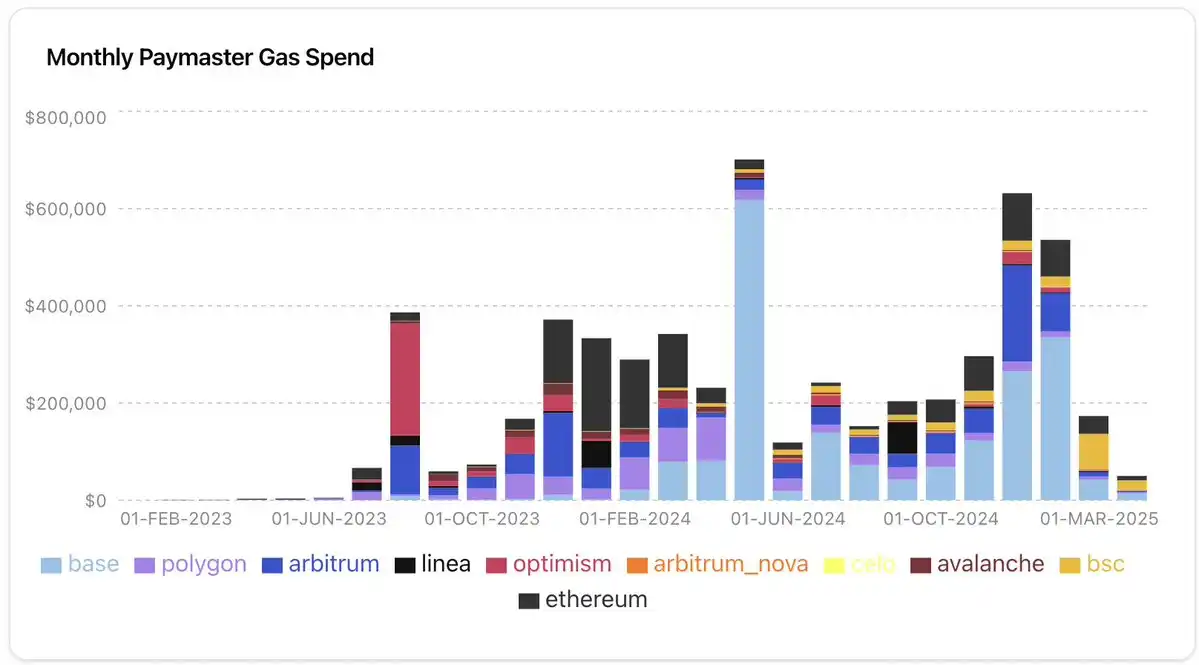
Through Paymaster, apps and users have spent over $3.4 million on UserOp fees, with main providers including @biconomy, @pimlicoHQ, @coinbase, and @Alchemy. Despite the market contraction, overall spending in the first quarter of 2025 shows a downward trend, with @base ($391,117), @ethereum ($121,053), and @BNBCHAIN (approximately $112,493) still leading.
On-Chain Activity Ranking
· Base (43.2%): Entertainment and Social Hub — Dominant in Gaming (76.8%).
· Polygon (21.4%): Community Engagement Layer — NFTs (50.7%) and Telegram Wallet (42.3%).
· Optimism (8.5%): Security-Focused — Emphasizing Infrastructure Resilience.
· Celo (7.4%): Niche Expertise — Forecasting Market.
· BSC (4.2%): Value Transfer Layer — Token-Focused, Highest Gas Costs.
Data Analysis
Before delving into data analysis, it is crucial to understand two key metrics:
· Tx/Wallet (Transactions per Wallet) — Measures the average number of transactions completed per wallet. A low value (e.g., ~1.0) indicates one-time usage activities (e.g., minting NFTs or claiming airdrops). A high value (e.g., ~25) indicates repeated engagement (e.g., active trading, gaming, or bot operations).
· Cost/Tx (Cost per Transaction) — Represents the average cost per transaction. In a Gasless system, it reflects the fee waived per transaction rather than the fee paid by the user.
1. NFT Projects: Numerous Wallets Usually = One-Time Accounts
· Piggybox: → Approximately 1 tx/wallet, ~$0.004/transaction.
· Somon Badge: → Approximately 1.4 tx/wallet, ~$0.007/transaction.

Interpretation: The 1:1 wallet-to-transaction ratio (Piggybox) strongly suggests minting or claiming activity. Piggybox is an NFT obtained during EARN'M registration, plus a lottery box that may yield EARNM tokens.
One-Time Surge: Many wallets engage in only one transaction (initial minting/claiming) and do not return thereafter, hence the near-perfect 1:1 ratio.
Ranking: Due to many new wallets engaging in minting, Piggybox ranks high on the overall leaderboard. However, if excluding one-time wallets, it might drop from the top five, indicating very low retention rates.
2. Token: Concentration of Token Transactions in a Few Projects
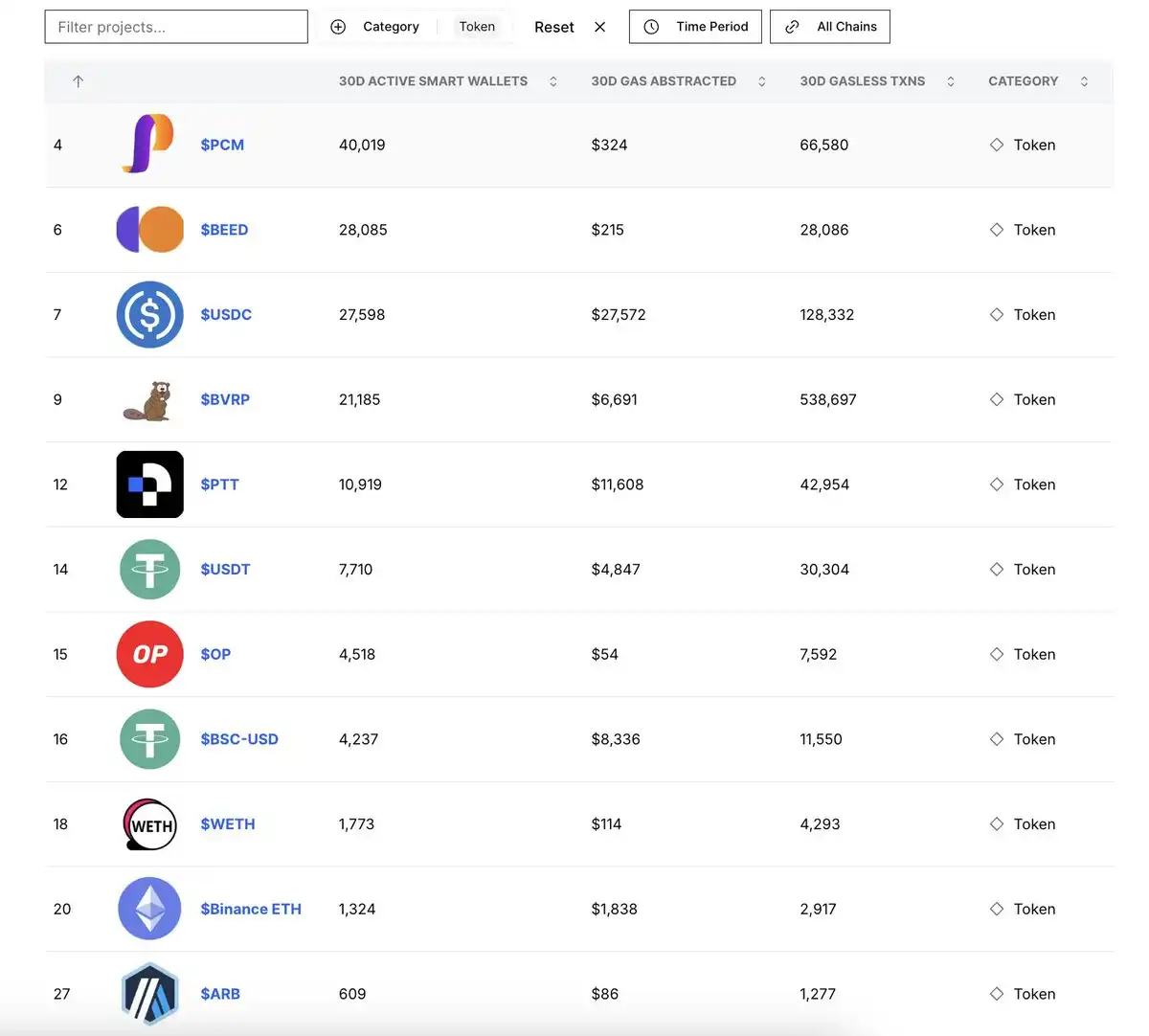
The list includes 26 token projects, far exceeding other categories. Two tokens, $BVRP and $USDC, accounted for over 667k transactions, representing the majority of the transaction volume.
· $BVRP: → ~25 tx/wallet at $0.012/tx.
· $USDC: → ~4.6 tx/wallet at $0.21/tx.
Interpretation:
· This concentration indicates that not all "token" projects are equally active; rather, a few heavyweight projects are driving the total volume.
· $BVRP demonstrates high transaction activity relative to the number of wallets, indicating high user engagement on these platforms, with frequent automated or repetitive transactions.
3. Gaming: One "Hit Game," but Attention Needed on Wallet/Transaction Ratio
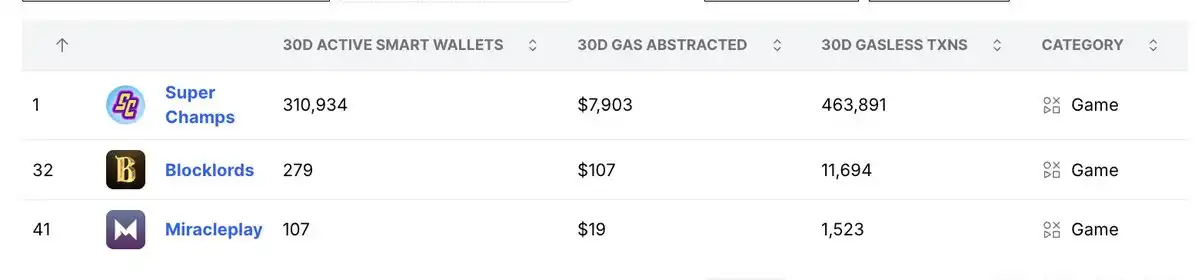
· @SuperChampsHQ: → Approximately 1.49 tx/wallet, ~$0.017/transaction.
· @BLOCKLORDS: → Approximately 42 tx/wallet, ~$0.009/transaction.
· @miracleplay_cn: → Approximately 14 tx/wallet, ~$0.012/transaction.
Interpretation:
· Super Champs dominate the overall gaming usage (463k vs. the sum of others at ~13k), but each wallet executes only about 1-2 transactions.
· Blocklords has fewer wallet numbers but an extremely high transactions per wallet ratio (~42). This is often related to robot-driven repetitive operations, as Blocklords' David Johansson stated: "They are fighting robots."
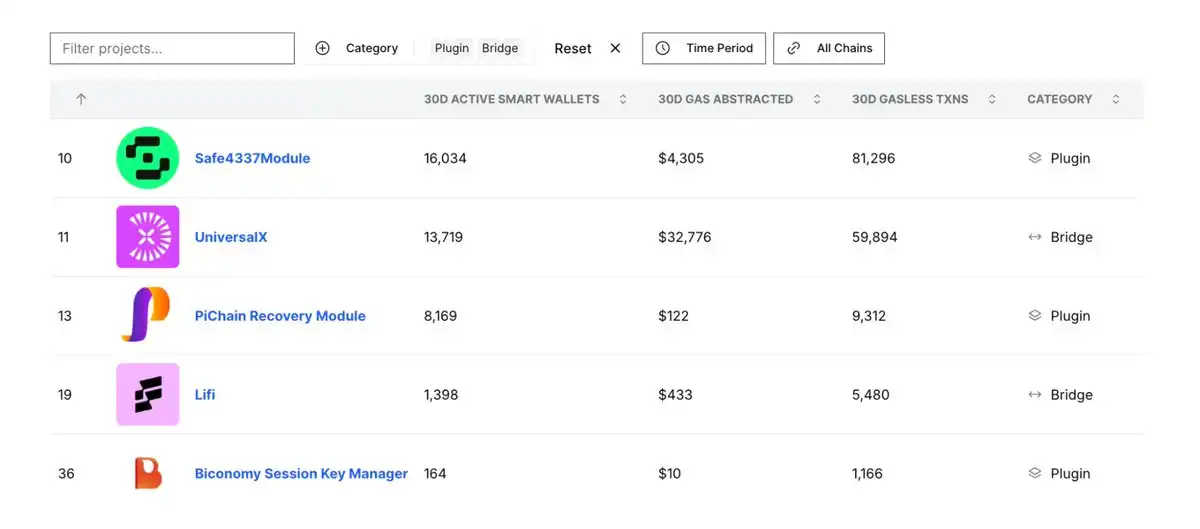
4. Bridging and Plugins: Moderate but Stable Usage, High Gas Costs
· UniversalX: → Approximately 4.4 tx/wallet, ~$0.55/transaction.
· Safe4337Module: → Approximately 5.1 tx/wallet, ~$0.053/transaction.
Interpretation:
· Behind-the-Scenes Tools: Infrastructure tools like bridges and plugins do not have the same "headline" transaction volume as tokens or games, but they maintain stable usage due to multiple dApp dependencies.
· Ecosystem Health Metrics: The moderate usage of infrastructure services indicates their real utility, rather than hype-driven spikes.
5. Chain Specialization Is Emerging
· @base: 99.5% of gaming wallet activity (310,934 out of 312,361 wallets).
· @0xPolygon: Dominant in NFT/social activity (87% of ecosystem NFT wallets).
· @BNBCHAIN: Leading in high-value bridge transactions (23.2% of all Gasless transactions).
· @Celo: Strong performance in prediction markets (25,574 wallets, 12.7 tx/wallet).
6. Cross-Chain Cost Differences
A 100x cost difference between different chains is driving specific application categories to concentrate on particular chains:
· Ethereum: $2.41 per Gasless transaction (highest).
· BSC: $0.50 per Gasless transaction.
· Base: $0.02 per Gasless transaction (lowest among major chains).
· Polygon: $0.03 per Gasless transaction. Argument: A 100x cost structure difference between different chains will lead to specific application categories concentrating on particular chains, regardless of technical similarities. Games and social apps are economically unfeasible on high-cost chains.
Overall Situation
· NFT adoption may involve minting to tens of thousands of wallets at once (e.g., Piggybox), but the reuse rate is extremely low.
· Infrastructure (bridges, plugins) remains stable with moderate transaction volume, usually with high per-transaction costs (bridges) or stable off-chain usage (plugins).
· The differences in per-wallet transaction counts across all categories highlight distinct usage patterns: some highly repetitive, while others are purely one-off interactions.
· Finally, the engagement of a large number of projects is close to zero, indicating that relying solely on free Gas is insufficient to generate demand; dApps need a real value proposition to retain users.
Summary
Account abstraction and Gas sponsorship can indeed boost transaction volume and user onboarding, but the real test is repeat engagement. By combining wallet counts, waived Gas fees, and no-Gas transaction volumes, the data highlights the phenomenon of concentrated usage within each category, often stemming from one or two star dApps or large-scale one-time claim events. Projects like Piggybox demonstrate how a near 1:1 ratio of wallets to transactions can propel an NFT project to the top ranks but may quickly fall off after filtering out one-time accounts. Meanwhile, bridge and plugin solutions demonstrate more stable moderate transaction volumes, reflecting the ecosystem's true needs rather than transient hype.
The Role of the ERC-4337 Smart Wallet
All these trends—Gasless gaming, seamless DeFi, chain specialization—are driven by the ERC-4337 Smart Wallet.
Unlike traditional EOAs (Externally Owned Accounts), smart wallets introduce automation, security, and flexibility, significantly enhancing the user experience.
What Is an ERC-4337 Smart Wallet?
A smart contract wallet or smart wallet is a programmable Ethereum account that enhances the user experience through the following functionalities:
Batch Transactions—Users can batch multiple operations (e.g., approve + swap on a DEX) into a single transaction.
Gas Fee Abstraction—Users do not need to hold ETH to pay gas fees; the fees can be covered by a sponsor or paid with other tokens.
Security—Users can authenticate themselves through passwords, social recovery, or multi-factor authentication instead of using less secure seed phrases.
How Does Gasless Transaction Work?
When a user initiates a transaction, the Paymaster (a special type of smart contract) can step in to pay the Gas fee or allow the user to pay using any held ERC-20 token. This significantly lowers the barrier of entry for new users, making blockchain applications seamless like Web2 apps.
However, ERC-4337 also faces significant adoption challenges, with the aforementioned retention issues possibly stemming directly from the following key limitations:
· Technical Barriers: Complex components like UserOperations, Bundlers, and EntryPoint contracts pose a steep learning curve for regular users and developers.
· Cost Concerns: While Gasless transactions are beneficial for users, implementing the full stack may be costly, and the profitability of Bundlers is unstable during Gas fluctuations.
· Reliability Issues: Network congestion can lead to transaction delays, and complex validation logic introduces potential security vulnerabilities.
· User Experience Gap: Multi-chain fragmentation results in inconsistent wallet experiences, hindering seamless cross-chain management.
Conclusion
Account abstraction and Gas sponsorship have successfully boosted transaction volume and new wallet registrations, but the real challenge is sustained engagement. Data shows:
· Many dApps experience one-time spikes in usage (such as NFT minting, airdrops), rather than long-term retention.
· A few projects drive the majority of activity, while many others struggle to attract genuine user demand.
· Bridging and infrastructure solutions demonstrate more stable usage rates, highlighting real utility over hype.
While ERC-4337 has achieved Gasless transactions and improved user experience, its complexity and cost barriers limit mainstream adoption. EIP-7702 addresses these issues by:
· Allowing EOAs to engage in account abstraction: The core issue with ERC-4337 was excluding EOAs, requiring users to switch to a smart contract wallet. EIP-7702 resolves this by allowing EOAs to temporarily adopt smart contract code, enabling access to Gas sponsorship (paying fees with ERC-20 tokens) and batch transactions (such as approving and spending ERC-20 tokens in a single transaction).
· Simplify Complexity and Cost: Allow EOA to temporarily adopt smart contract functionality, reduce the need for permanent wallet contracts, lower Gas expenses, and decrease reliance on Entry Points or Bundlers.
· Improve Efficiency: Introduce transaction type 0x04 for batch EOA operations, providing a more streamlined alternative to ERC-4337 UserOps.
· Simplify Infrastructure: Restrict smart contract code to transaction execution, reducing reliance on alternative mempools and Bundlers.
· Empower Developers: Integrate with ERC-4337 and provide a flexible, low-friction upgrade path.
While ERC-4337 laid the foundation, EIP-7702 will make smart wallets cheaper, simpler, more accessible, accelerating the next wave of Web3 adoption.
You may also like

Why Is Bitcoin Down Today? What the Hawkish FOMC Means for SpaceX, Gold and Nasdaq

OKX Star analyzes Binance's competitive advantages: when regulation levels the playing field, competition has just begun

Full version of the debut Q&A! Federal Reserve Chairman Waller: Sticking to the 2% inflation target, establishing five special working groups, individual did not submit the dot plot

From Disruptor to Shadow Market: The Crypto Market is Becoming a Colony of Traditional Finance

Dalio's important long article: How to position in the current market environment?

DeepSeek Financing Story

Morning Report | Illinois signs the strictest digital asset tax law in the U.S.; RWA tokenization market size surpasses $43 billion, institutions accelerate the migration of on-chain assets
Morning Report | DeepSeek completes over $7 billion in financing, with a valuation exceeding $50 billion; Musk's personal wealth has surpassed the total market value of Bitcoin

Cursor, why did you get on Musk's spaceship?
In the name of charity, for the benefit of the family: How the Trump family turned charity into profit?

Will Gold Break $4,500 After Tonight's Fed Decision? What XAUT and PAXG Traders Need to Know
SharpLink CEO: How to understand that Ethereum developers have just surpassed 1 million?

Morning Report | MiCA grace period expires on July 1; Kalshi's trading volume in the first week of the World Cup breaks $5.1 billion, setting a record

The foundation of SpaceX's trillion-dollar valuation: Who is dividing Musk's annual capital expenditure of tens of billions?
How to exit after asset tokenization?
The stablecoin positioning battle escalates: When compliance is just a ticket to entry, will USD1 become the biggest winner?

A16Z: The sun bears witness, SpaceX is worth 7.5 trillion

Mergers and acquisitions in the cryptocurrency market are exceptionally active
Why Is Bitcoin Down Today? What the Hawkish FOMC Means for SpaceX, Gold and Nasdaq
OKX Star analyzes Binance's competitive advantages: when regulation levels the playing field, competition has just begun
Full version of the debut Q&A! Federal Reserve Chairman Waller: Sticking to the 2% inflation target, establishing five special working groups, individual did not submit the dot plot
From Disruptor to Shadow Market: The Crypto Market is Becoming a Colony of Traditional Finance
Dalio's important long article: How to position in the current market environment?
DeepSeek Financing Story


